(Article en anglais)
Wasserstoff – ob Schifffahrt, Stahlproduktion, Raffinerien oder Power-to-XAnwendungen – der Hoffnungsenergieträger der Zukunft kommt in vielen Branchen bereits zum Einsatz. Aufgrund seiner besonderen Eigenschaften birgt WasserstoffGas einige technische Herausforderungen für die jeweiligen Komponenten mit denen es in Kontakt kommt, sodass der Einsatz von korrosionsbeständigen Edelstahl unerlässlich ist. Dieser ist wiederum anfällig für Verschleiß und Fressen und genau hier setzt die Technologie des dänischen Pioniers für Oberflächenhärtung an.
Wasserstoff – das Element, welches an erster Stelle im Periodensystem steht und somit das kleinste und leichteste Atom unter allen Elementen ist – wird bereits seit einiger Zeit als größter Hoffnungsträger für die zukünftige Energieversorgung gehandelt. Mit einem Massenanteil von etwa 70 % ist Wasserstoff das häufigste chemische Element im Universum. Auf der Erde beträgt sein Massenanteil jedoch nur 0,87 % und ist zu einem Großteil im Wasser gebunden. Angefangen bei der Herstellung über den Transport bis hin zur Verwendung, überall wo Wasserstoff im Spiel ist werden gleichermaßen auch Edelstahlkomponenten eingesetzt, die je nach Anwendung zum Teil extremen Verschleiß und naturgemäß einem hohen Risiko zum Kaltverschweißen unterliegen.
Diesem Problem wurde in der Vergangenheit mit traditionellen Verschleißschutzverfahren begegnet und die jeweiligen Bauteile mit einer auftragenden Beschichtung (z.B. Hartchrom, DLC oder Chromcarbid) oder klassischen Plasmanitrieren oder Salzbaddiffusionsschichten geschützt. Diese Prozesse sind jedoch bekannt dafür die Korrosionsbeständigkeit der Edelstahlteile negativ zu beeinträchtigen.
Die Lösung für diese Dilemma – eine Oberflächenhärtung, die vor Verschleiß und Fressen schützt und gleichzeitig die Korrosionsbeständigkeit der Werkstoffe aufrechte erhält oder sogar noch verbessert – wurde von den Gründern des dänischen Unternehmen Expanite entwickelt und kommt immer häufiger auch im Bereich Wasserstoff zur Anwendung. So werden zum Beispiel Bauteile von Armaturen und Kupplungssysteme gehärtet, die in der Wasserstoffinfrastruktur zum Einsatz kommen bis hin zu Komponenten für Brennstoffzellen.
Wasserstoffversprödung nachhaltig vorbeugen
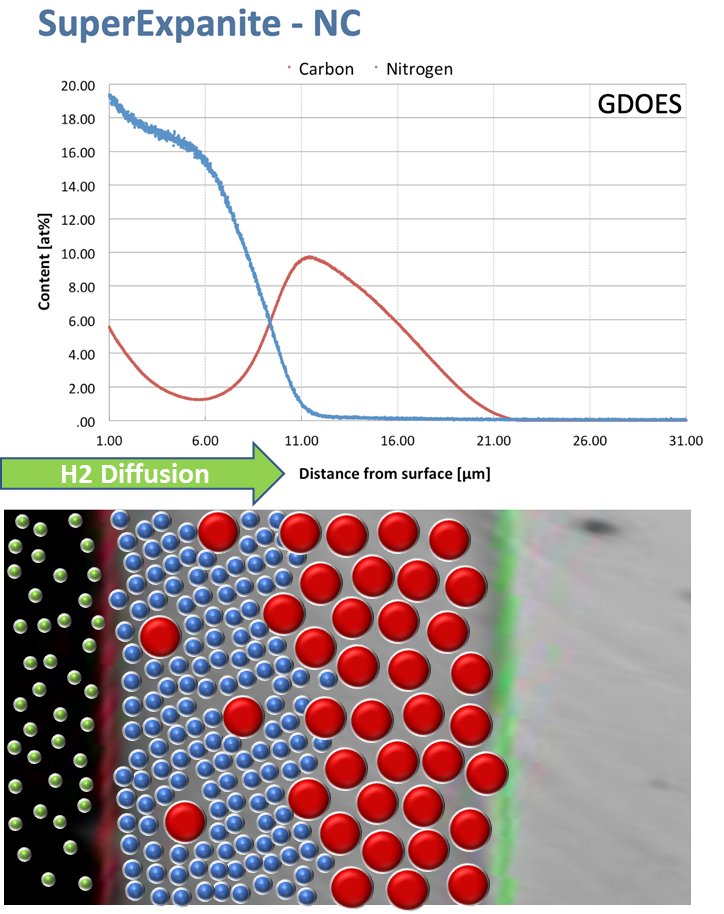
„Oft fragen unsere Kunden, ob sich durch die Expanite-Technologie die Neigung zur gefürchteten Wasserstoffversprödung verschlechtert, was jedoch nicht der Fall ist,“ erklärt Dr. Holger Selg Applikationsexperte und Expanite Sales Director DACH und geht weiter ins Detail: „Die Ursache der Wasserstoffversprödung ist auf die Diffusion des Wasserstoffs in den Werkstoff zurückzuführen und in der Theorie fungiert die Expanite-Schicht in gewisser Weise als Diffusionsbremse. Die mit Stickstoff und Kohlenstoff aufgeladene Expanite-Oberfläche ist für den Wasserstoff schwerer zu durchdringen als eine unbehandelte Oberfläche.“
Die speziell für korrosionsbeständige Werkstoffe entwickelte Expanite-Technologie bietet sowohl für austenitische, martensitisch, ferritische und DuplexEdelstähle aber auch für kostspielige NickelBasislegierungen wie z.B. Inconel und Hastelloy eine Lösung. Für Titanwerkstoffe wird der neue Spezialprozess ExpaniteHard-Ti eingesetzt, den das Expanite-Experten-Team in Dänemark in den letzten Jahren zur Marktreife entwickelt hat. .
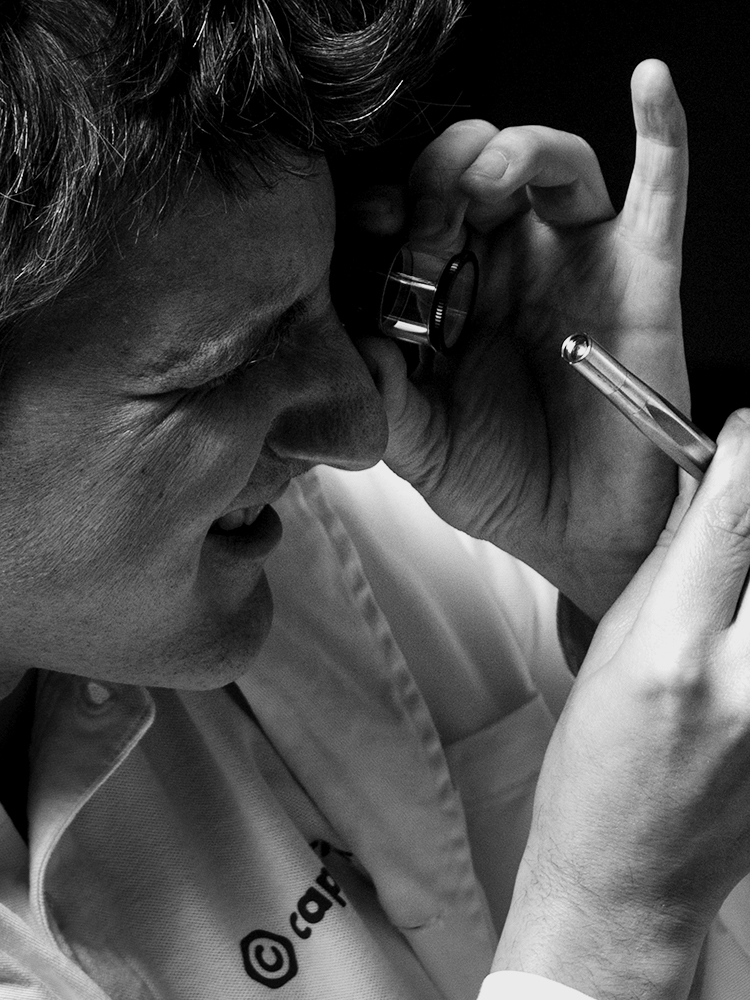
Engineer Zsolt Pataki wanted to create the ultimate fountain pen using innovative production methods with advanced materials. The result is a fountain pen made from a solid titanium bar for the ultimate weight, look and feel, hardened by ExpaniteHard-Ti to make it long-lasting and virtually unscratchable.
Hunting for the superior scratch resistance
Aerospace engineer Zsolt Pataki got a crazy idea; he wanted to create a unique fountain pen using his experience from aerospace in design, materials, and manufacturing. He chooses titanium grade 23 from the very beginning of the development process, but also knew that he wanted to go further. Mr. Pataki states: “In my search for increased wear resistance of the titanium, I was eager to avoid the hurdles of a coating; adding layers affecting the dimensions combined with the risk of layers chipping off – as I preferred a monolithic design with the original titanium surface instead of a coating”.
In the search for alternatives to coating, Mr. Pataki attended a webinar with Expanite presenting their unique hardening solution for titanium. “I soon realized that the ExpaniteHard-Ti process was the only matured and commercially available interstitial hardening technology for titanium. The webinar combined with the details of the technology on their web site helped me to develop realistic expectations and I reached out to them”, Mr. Pataki continues.
The solution
The ExpaniteHard-Ti process provides highly effective protection against wear and scratches. The method is not a coating process, hence all the drawbacks of coatings, including the risks of chipping/spalling off and inconsistencies in layers are completely avoided. In fact, it is the surface of the material itself, which is hardened. The ExpaniteHard-Ti process has a significantly greater level of protection against scratches than that afforded by the hardness of the base material and the hardened parts retains the design colour or as Mr. Pataki describe it: “I tried hard to scratch the pen after the process, but it is practically impossible – I made before and after comparison and the results are spectacular; the pen is now virtually unscratchable”
Professional knowledge sharing
Through the dialogue with the Expanite team, the optimal solution to increase scratch resistance of the fountain pen was found – Mr. Pataki states: “Throughout the whole process, the Expanite team has been very supportive and open to discuss questions and possible issues ensuring that I got exactly the solution that suited my requirements for the pens and the fact that the results were much better than advertised in terms of case depth of the hardened zone!” The ExpaniteHard-Ti process provides highly effective protection against wear and scratches.
About Capillaris
Capillaris was founded by aerospace engineer Zsolt Pataki. Working from his workshop in Budapest,
Hungary he created each sole piece of the fountain pen carved out of solid titanium himself. The
concept features a lightweight monolithic construction pen with continuous outer contour and
hexagonal sides reminiscent of a supersonic airfoil which enables the pen to lay stable on a desk. Visit
www.capillaris.eu for more.
About Expanite
Expanite offers state-of-the-art solutions for surface hardening treatment of stainless steels and titanium.
With Expanite’s processes, it is possible to increase the material’s surface hardness tenfold while at the
same time maintaining and even increasing its corrosion resistance. Expanite is a global organization with
a combined development and production facility near Copenhagen, Denmark, and hardening capacity in
both US, Germany, Korea and China. Expanite’s solutions are flexible and can be introduced directly into a
customer’s own production line as part of a licensing arrangement.
(Article en anglais)
“Expanite, the Danish specialist in heat treatment and surface hardening of stainless steel and titanium, is thrilled to announce the addition of Thorsten Schild as Business Development Manager. With 25 + years expertise within the field, the appointment of Thorsten Schild will further strengthen Expanite’s commercial and technical service, and thereby support the companies ambitious growth strategy.
Prior to joining Expanite, Thorsten Schild worked for Bodycote’s S3P division as group sales director, and he was one of co-founders of BorTec-SMT. All-in-all, Thorsten Schild can in many ways be regarded as one the most experienced people within sales and marketing of stainless steel surface hardening. Over more than 25 years, he has assisted countless customers across many industries globally on finding solutions for wear and galling on stainless steel.
About Expanite: Expanite is a Danish company specializing in heat treatment and surface hardening of stainless steel and titanium. Expanite has established itself as a pioneer and trusted partner in the industry. The sustainable and patented surface hardening processes improves galling, wear and corrosion resistance on stainless steel and titanium parts in a wide range of applications and industries. The company has its head office in Hillerød near Copenhagen and service centers and licensees in the USA, Germany, Korea, and China.
(article en anglais)
Expanite announced that Frederick Halbout has joined the company as Nordic Sales Manager. In this role, Frederick will be responsible for managing the development of the sales activities in the Nordic market.
Frederick brings many years of experience within international sales and marketing activities and brings extensive knowledge of the Nordic markets to the Expanite team.
Before joining Expanite, Frederick has worked several years at Oerikon Balzers Coating as KAM within Technical Sales and, and has a broad knowledge on surface technology and materials. Frederick knows what it takes to work with clients in a technical market, understand their needs and guide them in the right direction order to find an optimal and/or tailored solution.
Corrosion-resistant stainless steel is widely used in industry and trade due to its outstanding properties. Despite its numerous advantages, particularly its resistance to corrosion in numerous media, stainless steel also has considerable weaknesses that sometimes severely limit its application. One of these weaknesses is its susceptibility to cold welding or galling, which can occur particularly with screw connections. Surface hardening offers a solution to this problem.
Galling on stainless steel
Galling can be favored by various aspects, such as insufficient surface hardness, excessive roughness or lack of lubricants. Nevertheless, fasteners are essential in many applications to ensure particularly frequent assembly and disassembly, or high tightening torques. It is therefore important to carefully adjust the properties of such elements.
Galling can be favored by various aspects, such as insufficient surface hardness, excessive roughness or lack of lubricants. Nevertheless, fasteners are essential in many applications to ensure particularly frequent assembly and disassembly, or high tightening torques. It is therefore important to carefully adjust the properties of such elements. When fasteners are jammed due to galling, their removal can be an enormous challenge without damaging the affected bolt or destroying the associated nut.
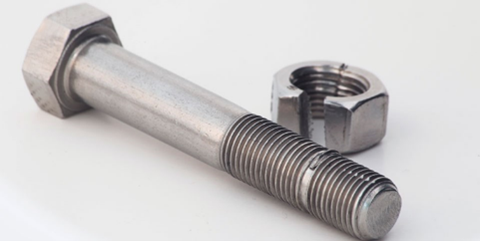
Fig.1: Symbolic image of a cold-welded screw connection
Surface hardening: the key to the solution
Surface hardening, a process in which only the surface layer of a workpiece is hardened, has the potential to significantly improve the seizure behavior of stainless steel screws. This diffusion-based process increases the hardness of the surface through solid solution hardening and reduces its susceptibility to plastic deformation. Depending on the material, the corrosion resistance is maintained or improved and neither the stiffness nor the ductility of the base material is impaired
The Process
Surface hardening is not an applied coating, but a diffusion-based thermo-chemical surface hardening process. Although classic processes for the surface hardening of corrosion-resistant stainless steels have been available to the industry for some time, their application has two main disadvantages: firstly, all classic processes such as On the other hand, the hardness values of stainless steels usually hardened with nitrogen or carbon drop very quickly, i.e. the hardening depth is only a few micrometres and the underlying base material is very soft, which can potentially lead to the egg-shell effect.
In contrast, Expanite has developed its process (SuperExpanite®), in which not only the outermost layer but also the underlying material is hardened to a greater depth which also contributes to an improvement in corrosion resistance in many cases.
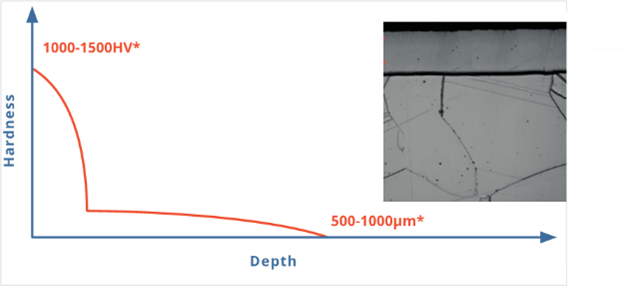
In many cases, a two-stage process is used in the Expanite treatment for stainless steels, in which nitrogen is introduced deep into the edge zone in the first step (high-temperature process), whereby the material is hardened to approx. 300 HV (austenitic materials)-850 HV (martensitic materials) by up to 1 mm. In the second process step, the so-called low-temperature process, the workpiece is heated to a maximum of 470°C and the surface layer is hardened to 1100-1,300HV at a depth of 5-30µm by incorporating carbon and nitrogen (see Fig. 2).
By combining the two process steps, the so-called eggshell effect, which occurs in most surface hardening processes, can be avoided, which offers the decisive advantage for numerous applications
Fig. 2: Micrograph of an AISI 316L material sample; under the extremely wear-resistant surface layer (produced in the « Low-T » process, approx. 1,200 HV) there is a medium-hard transition layer (250-300 HV), which is set in the « High-T » process.
Wear resistance
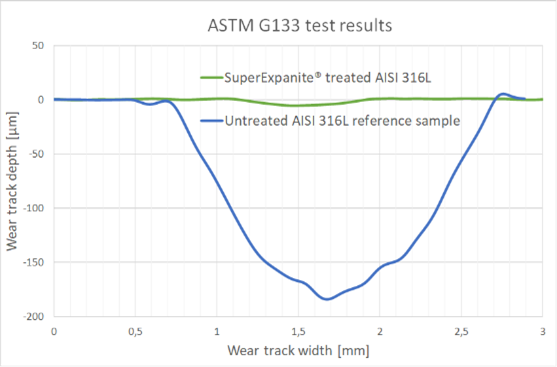
To test wear resistance, Expanite tested some 316L samples hardened using its SuperExpanite® process to ASTM standard G 98. In this procedure (see Fig. 3), a ceramic test specimen is subjected to a contact pressure of 25N and moved back and forth on a test specimen. The wear volume is determined after a sliding distance of 100 meters. The results are shown in Fig. 2: The 316L sample with SuperExpanite is more resistant to abrasion by a factor of 125 than the untreated sample
Fig. 3: Wear measurement according to ASTM G98
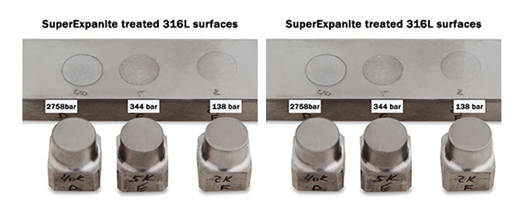
Following ASTM G98, a cold wear test was carried out with test specimens made of 1.4404, the results of which are shown in Figure 4. In comparison to the un-hardened test specimens, which already exhibit galling at a contact pressure of 35 bar, the test specimens hardened by Expanite do not show any galling even at a contact pressure of 2,068 bar – although the first plastic deformations occur due to the yield strength being exceeded. The risk of galling is therefore completely eliminated in the case of both hardened friction partners.
Fig. 4: Test specimens according to ASTM G98 test
Wear resistance
Although the basic intention of conventional surface hardening processes is to produce harder surfaces, this is usually at the expense of corrosion resistance.
This is where the Expanite process comes in. Tests have shown that 316L samples hardened with Expanite can spend up to 1,000 hours in a salt spray chamber without showing signs of corrosion.
In some cases, the corrosion resistance can even be significantly increased by the Expanite surface hardening process, even beyond the level of the unhardened base material. (Fig. 5). This effect is caused in particular by the nitrogen dissolved in the surface layer.
Environmentally friendly
Despite their widespread use, conventional surface layer hardening processes have various disadvantages. Harmful chemicals such as fluorides, chlorides, molten salts etc. are used. SuperExpanite® , on the other hand, which is produced using the two-stage process described above, is characterized by a resource-saving approach. No natural resources are consumed, and no polluted wastewater is produced. With a low energy consumption of just 1.9 kWh/kg of hardened stainless steel and without the use of harmful chemicals, it represents an environmentally friendly and sustainable alternative.
Summary and applications
To summarize, the nitrocarburizing process specially developed by Expanite delivers excellent results in terms of both hardness and corrosion resistance for all stainless steel materials, not just limited to individual alloys. The process is therefore recommended for all types of stainless steel screws and fittings to extend the service life of the corresponding components and thus ensure increased product safety and interchangeability.
About Expanite
Expanite offers state-of-the-art solutions for surface hardening treatment of stainless steels and titanium. With Expanite’s processes, it is possible to increase the material’s surface hardness tenfold while at the same time maintaining and even increasing its corrosion resistance. Expanite is a global organization with a combined development and production facility near Copenhagen, Denmark, and hardening capacity in both US, Germany, Korea and China. Expanite’s solutions are flexible and can be introduced directly into a customer’s own production line as part of a licensing arrangement. Learn more on www.expanite.com.
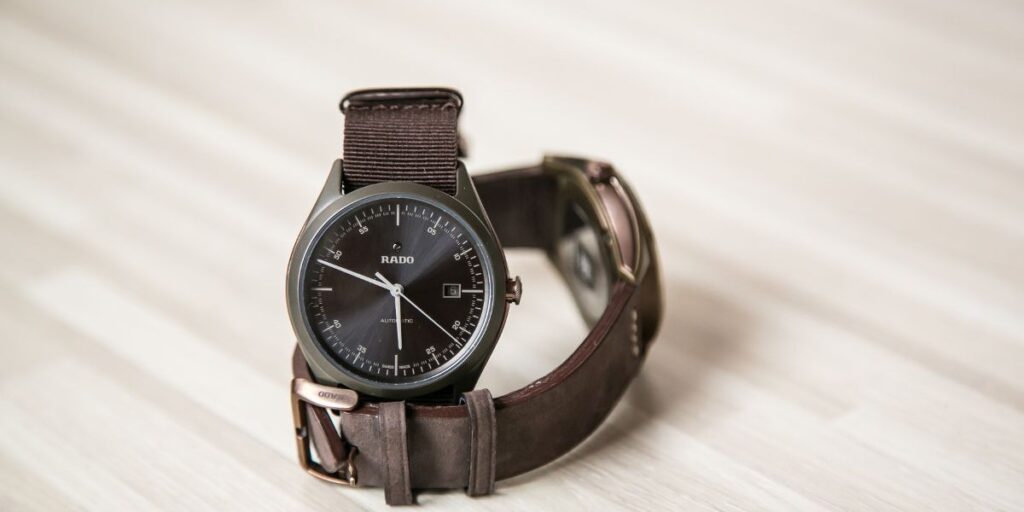
Expanite®, le spécialiste danois du traitement de surface, a aidé la marque horlogère suisse Rado® à développer un procédé de durcissement améliorant la résistance à l’usure et aux rayures de ses montres haut de gamme en titane – tout en conservant leur couleur d’origine. Ce qui semblait autrefois impossible est désormais possible.
Expanite fournit des solutions et des perspectives!
Nous sommes heureux de vous présenter la dernière newsletter Expanite de 2021 ! Dans les pages qui suivent, vous trouverez des exemples de la polyvalence de la technologie Expanite – que le défi soit le grippage et la corrosion sur des raccords de pétrole et de gaz ou le remplacement/renforcement des revêtements DLC – Expanite résout les problèmes et fournit des solutions. Nous profitons également de l’occasion pour conclure une nouvelle année avec plus de 500 personnes ayant assisté à nos webinaires et pour rappeler à tous nos clients actuels et futurs que les fours Expanite fonctionneront tout au long de la prochaine période de vacances.
Les perspectives 2022 pourraient être brouillées par de sérieux défis tels que les goulots d’étranglement de la chaîne d’approvisionnement, l’inflation élevée et le Covid-19 – mais ici et maintenant, notre objectif est de regarder vers l’avenir – et au sein d’Expanite, il y a beaucoup de bonnes choses à attendre ! D’une part, nous allons augmenter nos capacités de production en Allemagne, aux États-Unis et en Chine – ce qui signifie plus de fours, plus de flexibilité et un meilleur service. D’autre part, nous travaillons à améliorer notre présence numérique via un nouveau site web tout comme notre présence physique avec un nouveau site en Asie – restez à l’écoute pour en savoir plus en 2022.
Sur ces mots, nous souhaitons à tous nos fidèles clients, partenaires et fournisseurs, un joyeux Noël, de bonnes fêtes de fin d’année et nos meilleurs vœux pour une nouvelle année prospère.
Wishing you all a great summer; Expanite will cover for you when it comes to hardening!
The summer holidays are coming up, but as always, Expanite keeps the furnaces running and customer service is available throughout the summer months to ensure that deliveries can be received and returned!
I wish you all the best for your summer vacation.
Best regards, Thomas Abel Sandholdt
CEO, Expanite
When tomorrow is too late – try Expanite’s express service
A lot of logistic chains have been challenged over the last months with shortage of materials, increasing shipping time and lack of human resources – and more importantly, these challenges seem to continue over the summer and into the fall.
Almost every day, we’re helping one or more of our customers with catching up – our unique delivery system with lead times down to three working days is simply just better than what any of our competitors can offer.
We hope that you stay well and safe!
At Expanite, we just completed the 11th fiscal year in the company’s history and are happy to report that we once again managed to realize double-digit growth in sales for 2020 over 2019, despite the pandemic. This is only reached by having a unique combination of satisfied customers where our technologies add true value and a dedicated team of employees. Thanks to all; this gives us the platform to continue to develop and improve in all aspects of our business.
Since the foundation of Expanite, we have worked under three paradigms: (product) performance, sustainability and digitalization. Especially, the two last points have perhaps been less visible to our customers and surroundings, however, we’re about to change this. In the coming months we are planning to share more details on why we consider Expanite the most sustainable solution for surface hardening and how we use technologies such as industrial internet of things to ensure efficient execution of our services globally. Stay tuned.
As we prepare to leave one of the most challenging years in decades, we would like to look back at some bright sides for a moment and share a few highlights from our world with you.
Most importantly, we managed to keep our employees and their families safe from any serious effects of Covid-19, and by reducing working hours in the critical months during the lock-down, we managed to ensure that everybody had a job to return to when businesses reopened over summer and in the fall. In the recent months we have experienced a strong return in business – to an extend that makes it possible for us to grow sales in 2020 with double-digits compared to 2019. For us it’s a sign of Expanite having a robust base of loyal customers and a good level of newcomers.
As for 2021, we remain cautiously optimistic; we have a strong pipeline of new projects combined with the base from 2020. So we expect to increase capacity on the people and equipment side in all three regions: Europe, Asia and North America during 2021. We will return with more information in the coming newsletters.
Please let me use this opportunity to wish you all, customers, partners and friends of the company, a Merry Christmas, Happy Holidays and a prosperous healthy New Year.