(Articel auf English)
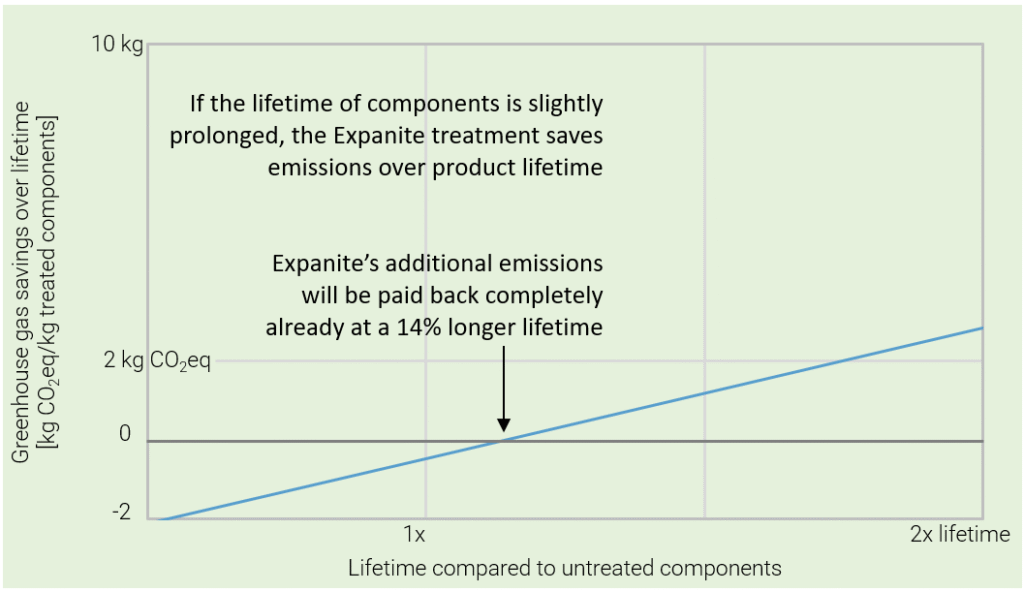
As the first company in the surface hardening and heat treatment industry, Expanite has completed an independently verified Life Cycle Assessment (LCA) that documents the environmental footprint of its hardening technologies. The results confirm what Expanite has long claimed that its processes have a low climate impact thanks to a low CO2 footprint and no use of toxic materials.
The findings of the LCA were very positive. The climate impact of Expanite’s processes on stainless steel surface hardening leads to only 0,23-0.46 kg CO2 eq per kg of treated material. When compared to the 10.5 kg CO2 eq/kg emissions of untreated stainless steel, the Expanite process adds only 2-14% of greenhouse gas emissions. This very low impact justifies investing or switching to Expanite is environmentally responsible and economically sound. The LCA documents that the Expanite processes are free from fluoride, hydrochloric acid and/or cyanides. The processes generate no toxic waste and, perhaps even more importantly, do not use solvents. The soot emissions from the Expanite processes are so low that there are no health risks. All Expanite sites are fully compliant with local and national environmental standards.
Viel Gerede – wenig Daten. So beschreibt Expanite, Spezialist für Randschichthärtung, den aktuel-len Stand der Nachhaltigkeit in der Wärmebehandlungsbranche. Doch nun verändert Expanite dies grundlegend. Als erstes Unternehmen der Branche hat Expanite eine unabhängig verifizierte Lebenszyklusanalyse (LZA) abgeschlossen, welche die Umweltbilanz seiner Härtungsverfahren do-kumentiert. Die Ergebnisse bestätigen, was Expanite seit Langem betont: Die eingesetzten Verfah-ren zeichnen sich durch eine geringe Klimabelastung aus – dank eines niedrigen CO₂-Fußabdrucks und dem Verzicht auf toxische Substanzen.
Transparenz als Grundprinzip
„Als wir damit begannen, den CO₂-Fußabdruck unserer Expanite-Prozesse zu dokumentieren, wurde schnell deutlich, dass es zwar viele schöne Präsentationen, aber kaum belastbare Daten gibt“, erklärt Thomas Sandholdt, CEO von Expanite. „Wir sind überzeugt, dass Transparenz Ver-trauen schafft – insbesondere in einer Branche, die bislang diesbezüglich wenig Offenheit zeigte. Unsere Gespräche mit Kunden zeigen: Regulatorische Anforderungen sind eine Herausforderung, gerade weil es an Daten fehlt. Deshalb haben wir ein unabhängiges Beratungsunternehmen mit Sitz in der EU beauftragt, eine vollständige Lebenszyklusanalyse unserer Verfahren durchzuführen.“
Unabhängige Daten belegen die geringe Umweltbelastung
Die Ergebnisse der LZA fallen äußerst positiv aus: Die Klimawirkung der Expanite-Verfahren zur Härtung von Edelstahl liegt bei lediglich 0,23–0,46 kg CO₂-Äquivalenten pro Kilogramm behan-deltem Material. Zum Vergleich: Die Emissionen für unbehandelten Edelstahl liegen bei rund 10,5 kg CO₂-Äquivalent pro Kilogramm – somit verursacht Expanite nur etwa 2–14 % zusätzlicher Treibhaus-gasemissionen. Dieser extrem geringe Einfluss rechtfertigt den Umstieg auf Expanite so-wohl aus ökologischer als auch aus wirtschaftlicher Sicht. Die Analyse bestätigt zudem, dass Expa-nite vollständig auf Fluoride, Salzsäure und Cyanide verzichtet. Es entstehen keine toxischen Ab-fälle, und besonders hervorzuheben ist der vollständige Verzicht auf Lösungsmittel. Auch Rußemis-sionen sind so gering, dass keinerlei Gesundheitsrisiken bestehen. Alle Expanite-Standorte erfüllen nationale und lokale Umweltvorgaben vollständig.
Herausforderung an traditionelle Wärmebehandler
„Unsere Marktforschung zeigt: Nachhaltigkeit und Dekarbonisierung gewinnen bei der Lieferanten-auswahl zunehmend an Bedeutung. Transparenz ist seit jeher ein zentraler Bestandteil unserer Un-ternehmensphilosophie. Unsere Türen stehen offen – Kunden sind jederzeit eingeladen, unsere Be-handlungszentren weltweit zu besuchen. Expanite wurde mit dem Anspruch gegründet, eine nach-haltigere Alternative in der Wärmebehandlung zu bieten. Unsere Botschaft an die Branche lautet: Fordern Sie von Ihren aktuellen Lieferanten belastbare Daten ein. Wenn diese keine vorweisen können, sollten Sie vielleicht mit Expanite sprechen“, so Sandholdt mit einem Lächeln.
Nachhaltigkeit geht über den CO₂-Fußabdruck hinaus
Expanites Vorteile im Bereich Nachhaltigkeit beschränken sich nicht auf den CO₂-Ausstoß. Durch die Kombination zweier Prozessschritte wird der sogenannte „Eierschalen-Effekt“, der bei vielen Härtungsverfahren auftritt, vollständig vermieden. Das Resultat: Überlegene Materialeigenschaften für eine Vielzahl von Anwendungen, etwa in Pumpen und Ventilen der Lebensmittelindustrie. Wei-tere Branchen, die von der gleichmäßigen Verbesserung hinsichtlich Verschleiß, Kaltverschwei-ßung und Korrosionsbeständigkeit profitieren, sind u. a. Automobilindustrie, Öl & Gas, Schiffbau und viele mehr.
Über Expanite
Seit 2010 bietet Expanite bewährte und zuverlässige Wärmebehandlungs- und Randschichthär-tungs-lösungen für Edelstahl, Titan, Nickelbasislegierungen und andere Sonderwerkstoffe an. Die Verfahren verbessern die Beständigkeit gegen Verschleiß, Kaltverschweißung und Korrosion und verlängern so die Lebensdauer kritischer Bauteile – bei gleichzeitiger Reduzierung des Bedarfs an Primärmaterialien. Der Hauptsitz des Unternehmens befindet sich in Hillerød bei Kopenhagen, wei-tere Servicezentren und Lizenznehmer gibt es in den USA, Deutschland, Korea und China. Das pa-tentierte Geschäftsmodell ermöglicht es Kunden, die Technologie über Lizenzverträge direkt in ihre Fertigungslinien zu integrieren. Weitere Informationen unter: www.expanite.com.
Der Frühling ist da – und mit ihm spannende Neuigkeiten von Expanite!
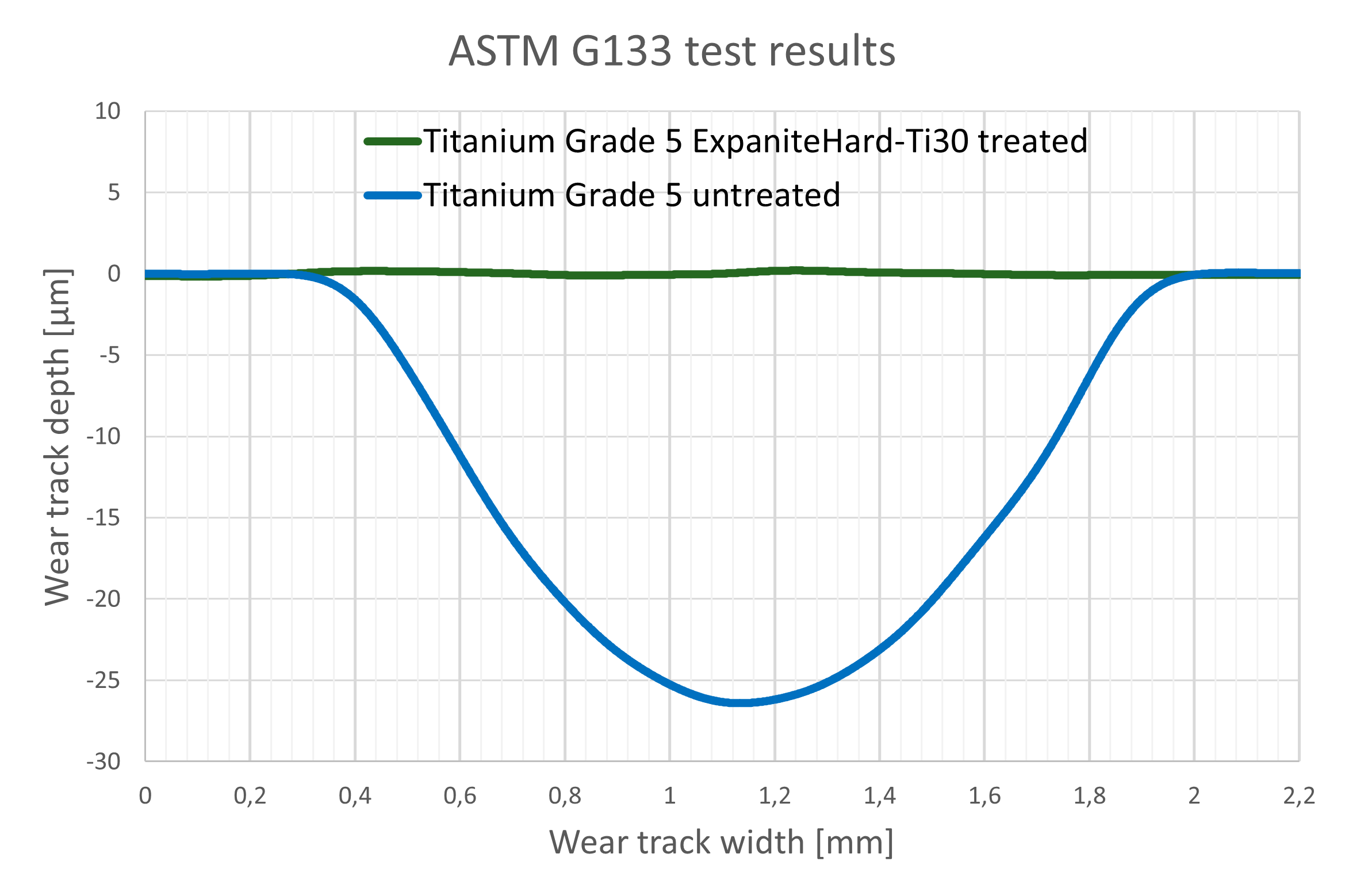
Wir haben aufregende Updates für Sie! In diesem Newsletter erfahren Sie, wie unser ExpaniteHard-Ti-Prozess die Verschleißfestigkeit von Titan Grade 5 auf ein neues Niveau hebt.
Lernen Sie unseren CTO, Thomas Strabo Hummelshøj, in der Reihe „Meet the Tech Team“ kennen. Entdecken Sie, warum immer mehr Branchen auf Hartverchromung verzichten, und begrüßen Sie mit uns unsere neuesten Kolleginnen und Kollegen in Europa und den USA.
Zum Abschluss werfen wir einen Blick auf die Umweltauswirkungen unserer Prozesse – mit unabhängig verifizierten LCA-Daten, perfekt für alle, die auf Nachhaltigkeit setzen. Ganz transparent, so wie Sie es von Expanite gewohnt sind.
(Artikel auf English)
Expanite® is expanding its U.S. Operations and Organization – adding signicant Heat Treatment Capacity and New Technologies! Expanite, the innovative heat treatment and surface hardening provider, is signicantly expanding its U.S. operations. As part of this strategic investment, Expanite is making its ExpaniteHard-Ti process for surface hardening of titanium available to North American customers, alongside the widely adopted SuperExpanite® processes enhancing wear, galling and corrosion resistance of stainless steel, nickel-based, and other specialty alloys. New Facility, Bigger Volumes, Larger Parts, and New Capabilities Expanite Inc., a subsidiary of Expanite A/S based in Denmark, is signicantly expanding its operations in North America with a major investment in a larger facility, tripling its heat treatment and surface hardening capacity.
Expanite Inc. is relocating to a new and larger facility in Twinsburg, Ohio and bringing in new furnaces to meet the growing demand for advanced surface hardening and heat treatment solutions across a wide range of industries. The new advanced furnaces – with chamber sizes up to 24x24x36” – are supplied and installed by Seco/Warwick. The new equipment will allow Expanite to process larger and more complex components while maintaining the unique hardening quality, widely accepted for improving product performance on stainless steel. The increased capacity and capabilities will further enhance the lead times and flexibility that Expanite is known for. This strategic expansion not only boosts Expanite’s ability to serve a growing number of industries such as pumps, valves, food & beverage processing equipment, medical devices and automotive, but also aligns with the company’s commitment to sustainability by offering greener alternatives to traditional technologies
“Our investment is all about meeting the growing demands from our North American customers,” says Thomas Sandholdt, CEO of Expanite. “We’re now able to handle much larger volumes while maintaining the fast lead times and flexibility that our customers expect from Expanite.” Expanite is bringing Patented Technology USA Commercial Heat Treater Expands for Hardening of Titanium to North America Expanite Inc. is now not only offering its well-known SuperExpanite processes for stainless steel but also its patented ExpaniteHard-Ti process — an advanced surface hardening solution designed for hardening of titanium parts.
Previously ExpaniteHard-Ti was only available from Expanite’s headquarters in Denmark. The ExpaniteHard-Ti process significantly improves wear and galling resistance, extending life and expanding the possible applications of titanium components. “Our expanded capabilities mean we can now offer our full range of Expanite technologies, including the processes for titanium, right here in the U.S.”, added Claus Løndal, Country Manager, North America “This allows us to serve a wide range of customers while reducing lead times and costs”. Expanding Heat Treatment Capabilities Besides the proprietary Expanite standard vacuum heat treatment processes are offered from Expanite.
This includes hardening of tool steels (D2, A2, M2, H13, etc.), austenite annealing of stainless (304, 316, etc.), precipitation treatment of PH-steels (17-4PH, 13-8PH, etc.) and specialty treatment of alloys (Inconel 718, MU-metal etc.). The addition of vacuum heat treatment solutions extends Expanite’s capabilities, offering more solutions, and greater flexibility and ensuring customers receive hardening solutions tailored to their specific needs. A Stronger Team, A Stronger Presence To support this expansion, Expanite Inc. has also strengthened its team with additional specialists in surface hardening and heat treatment, ensuring that the growing demand is met with the highest level of service and expertise while reinforcing the company’s commitment to sustainability and innovation.
(Artikel auf English)
Expanite offers an innovative technology that prevents wear, galling, and corrosion of components in stainless steel or titanium by hardening the material in a pure-gas environment without using harsh chemicals, leaving no toxic waste and with a low carbon footprint.
Hardening of parts such as gears and other essential products made from stainless-steel alloys is a vital and necessary process to ensure those parts perform optimally.
Expanite, a company that was born from research at The Technical University of Copenhagen, has grown its innovative process of hardening stainless steel more efficiently than previous methods.
Besides the proprietary processes for stainless steel and titanium, Expanite offers specialty heat treatment solutions including hardening, tempering, solution treatment, aging, and annealing for nickel-based alloys such Monel®, Inconel® or Mu-metal, stainless steels, titanium, and other specialty materials.
“You can easily take stainless steel and put it in and harden it, but you lose corrosion properties right away if you don’t know how to do it,” said Claus Løndal, country manager North America with Expanite. “We do that without losing corrosion properties.”
The beauty of Expanite’s hardening process is it works with any stainless-steel alloy, according to Løndal.
“We can take all stainless-steel alloys – and I mean every stainless-steel alloy, as long as they are defined as stainless steel,” he said. “That means that it has to have around 12 percent chrome in the alloy. And we can harden them all. We can also harden some other alloys and titanium.”
Hardening stainless steel
Stainless steel is an amazing material, according to Løndal, but it isn’t a very hard material.
“If you go out and — you probably have a refrigerator or a dishwasher that is a stainless-steel surface – and if you take a knife, you can scratch it, or you can scratch it with your fingers; that’s how soft it is,” he said. “We can harden it almost 10 times as hard as that in the surface. It’s a surface hardening of the material. Our advantage is that you don’t see a drop in corrosion properties after our process.”
Corrosion is a common problem when dealing with stainless steels, and — if not dealt with — can become a hazard for industries using food and beverage equipment or medical and aerospace sectors, according to Løndal.
“You don’t want your parts to corrode because, at some point, it will corrode so much that it goes to pieces,” he said.
(Artikel auf English)
Test Corrosion resistant stainless steel is widely used in industry and trade due to its outstanding properties. Despite its numerous advantages, particularly its resistance to corrosion in numerous media, stainless steel also has considerable weaknesses that sometimes severely limit its application.
One of these weaknesses is its susceptibility to cold welding or galling, which can occur particularly with screw connections. Surface hardening offers a solution to this problem.
Improving Galling Resistance on Stainless Steel
Galling can be favoured by various aspects, such as insufficient surface hardness, excessive roughness or lack of lubricants. Nevertheless, fasteners are essential in many applications to allow for particularly frequent assembly and disassembly, or high tightening torques. It is therefore important to carefully tailor the properties of such elements.
When fasteners are jammed due to galling, their removal can turn out to be an enormous challenge, especially if it needs to be done without damaging the affected bolt or destroying the associated nut. Surface hardening, a process in which only the surface layer (few to tens of microns) of a workpiece is hardened, has been proven to significantly improve the seizure behaviour of stainless steel screws. The diffusion-based process increases the hardness of the surface through solid solution hardening and subsequently reduces its susceptibility to plastic deformation. Depending on the material, the corrosion resistance is maintained or even improved, and the stiffness of the base material is not impaired
The process
Surface hardening is not an applied coating, but a diffusion-based thermo-chemical surface hardening process. Although classic processes for the surface hardening of corrosion resistant stainless steels have been available to the industry for some time, their application has two main disadvantages. Firstly, all classic processes such as salt bath processes are known to reduce corrosion resistance. On the other hand, the hardness values of stainless steels usually hardened with nitrogen or carbon drop very quickly, i.e the hardening depth is only a few micrometers and the underlying base material is very soft, which can potentially lead to the ‘eggshell’ effect.
In contrast, Expanite has developed its proprietary technology SuperExpanite®, having solved those shortcomings as a priority. With this technological process not only the outermost layer but also the underlying material is hardened to a greater depth, which also contributes to an improvement in corrosion resistance in many cases.
A two stage process is used in Expanite’s treatment for stainless steels, in which nitrogen is introduced deep into the surface area in the first step called ExpaniteHigh-T (high temperature process), whereby the material is hardened to approximately 300HV for austenitic materials and 850HV for alloys with martensitic structure to a depth of up to 1mm. In the second process step, ExpaniteLow-T, the workpiece is heated to temperatures below 500°C and the surface layer is hardened to 1,100HV – 1,300HV at a hardening depth of 5μm – 30μm (depending on the solution). The hardening is achieved by incorporating large amounts of interstitial carbon and nitrogen.
By combining the two process steps, the so-called ‘eggshell’ effect, which occurs in most surface hardening processes, is avoided. This offers a decisive advantage for numerous applications that require improved load-bearing capacity.
(Artikel auf English)
Expanite has achieved remarkable outcomes through the application of SuperExpanite® hardening on AISI 316/1.4404 stainless steel intended for metallic food contact material. The testing, conducted in line with the Council of Europe Resolution CM/Res(2013)9, specifically targeted scenarios involving repeated food contact. Consequently, Expanite’s surface hardening process has been deemed safe for use in food contact applications.
The test results underscore the exceptional performance attained through Expanite’s surface hardening technique. The treated AISI 316 stainless steel showcased outstanding resistance and adherence to the rigorous conditions stipulated in the CM/Res(2013)9 test.
(Artikel auf English)
The REACH regulation was established by the European Union to better protect health and the environment from the dangers of chemicals. REACH, an acronym for Registration, Evaluation, and Authorization of Chemicals, defines how and under which conditions specific chemicals can be used within the EU. A solution to the above-mentioned problems involving stainless steels is surface hardening. This is not a coating process but a diffusion-based surface hardening process. Traditional methods for surface hardening corrosion-resistant stainless steels have been available to the industry for some time. However, they mainly have two disadvantages: they reduce corrosion resistance, and the hardness value of steels hardened with nitrogen or carbon often decreases rapidly at the material core. This means that the hardening depth is only a few microns, and the underlying structure is very soft, which can potentially lead to an „eggshell effect.”
Edelstahl ist aufgrund seiner besonderen Eigenschaften und Vielseitigkeit ein unverzichtbarer Werkstoff für medizinische Geräte und Implantate, die häufig mit Flüssigkeiten und Gewebe in Kontakt kommen. Die Korrosionsbeständigkeit von Edelstahl gewährleistet eine lange Lebensdauer und verhindert das Auftreten von Rost oder anderen Schäden, die die Funktion und Sicherheit von Medizinprodukten beeinträchtigen könnten..
Korrosionsbeständiger Edelstahl ist da her seit Jahrzehnten ein in der Medizintechnik weit verbreiteter Werkstoff und in den verschiedensten Legierungsvarianten auf dem Markt. Viele Unternehmen setzen insbesondere die austenitischen und Duplex-Varianten ein. Leider haben diese den Nachteil, dass sie aufgrund ihrer geringen Härte sehr verschleißanfällig sind und zu Kaltverschweißungen neigen.
ängige Verfahren zur Erhöhung des Widerstandes gegenüber Verschleiß oder Kaltverschweißen an Edelstahl-Bauteilen haben den Nachteil, dass nichtrostende Stähle nach der Behandlung zur Korrosion neigen. Beschichtungsverfahren, die dies verhindern können, sind materialauftragend und in vielen Fällen hinsichtlich der aufgetragenen Schichtdicke inhomogen, so dass es zu Materialanhäufungen an ebenen Strukturen und zu Materialfluchten an Ecken und Kanten kommt, wo der Schutz entsprechend geringer ist
Darüber hinaus können die Beschichtungen bei starken Dehnungen oder auch Schrumpfungen des Grundwerkstoffes aufgrund der unterschiedlichen Wärmeausdehnungskoeffizienten von Grundwerkstoff und Beschichtung reißen. Auch Konturen mit Hinterschneidungen und kleinen Öffnungen stellen zusätzliche Probleme dar, da Beschichtungen hier – je nach Beschichtungsverfahren – nicht aufgebracht werden können. Diese Schwierigkeiten zu umgehen, hat sich die Expanite GmbH, Anbieter von Oberflächenhärtungstechnologien aus dem schwäbischen Frickenhausen, zur Aufgabe gemacht.
Eine Lösung für die oben genannten Probleme bei nichtrostenden Stählen ist das Randschichthärten. Dabei handelt es sich nicht um ein Beschichtungsverfahren, sondern um einen diffusionsbasierten Oberflächen-Härteprozess. Klassische Verfahren zur Randschichthärtung von korrosionsbeständigen Edelstählen stehen der Industrie zwar schon seit geraumer Zeit zur Verfügung, haben aber im Wesentlichen zwei Nachteile: Zum einen führen alle klassischen Verfahren zu einer Verringerung der Korrosionsbeständigkeit. Zum anderen fallen die Härtewerte der üblicherweise mit Stickstoff oder Kohlenstoff gehärteten Edelstähle sehr schnell ab, das heißt, die Einhärtetiefe beträgt nur wenige Mikrometer und das darunter liegende Gefüge ist sehr weich, was potenziell zum Eierschaleneffekt führen kann.
Expanite hat dagegen ein eigenes, FDA-konformes Verfahren entwickelt, bei dem nicht nur die Randschicht, sondern auch das darunter liegende Material tiefer gehärtet wird: Das speziell entwickelte Nitrocarburieren ist ein thermochemisches Verfahren zur Behandlung von Stahl, bei dem Stickstoff und Kohlenstoff in die Oberfläche des Werkstücks eindiffundieren, um eine verbesserte Oberflächenhärte, Verschleißfestigkeit und Korrosionsbeständigkeit zu erzielen. Das Nitrocarburieren kombiniert die Vorteile des Nitrierens und des Carburierens in einem einzigen Verfahren.
Download Full Article from The Monty (English)