(Article en anglais)
As the first company in the surface hardening and heat treatment industry, Expanite has completed an independently verified Life Cycle Assessment (LCA) that documents the environmental footprint of its hardening technologies. The results confirm what Expanite has long claimed that its processes have a low climate impact thanks to a low CO2 footprint and no use of toxic materials.
The findings of the LCA were very positive. The climate impact of Expanite’s processes on stainless steel surface hardening leads to only 0,23-0.46 kg CO2 eq per kg of treated material. When compared to the 10.5 kg CO2 eq/kg emissions of untreated stainless steel, the Expanite process adds only 2-14% of greenhouse gas emissions. This very low impact justifies investing or switching to Expanite is environmentally responsible and economically sound. The LCA documents that the Expanite processes are free from fluoride, hydrochloric acid and/or cyanides. The processes generate no toxic waste and, perhaps even more importantly, do not use solvents. The soot emissions from the Expanite processes are so low that there are no health risks. All Expanite sites are fully compliant with local and national environmental standards.
Une année de croissance, d’innovation et de durcissement de surface durable – Expanite a terminé son analyse du cycle de vie (ACV)
Alors que nous nous apprêtons à tourner la page de 2024, j’aimerais prendre un moment pour faire le bilan de l’année que nous quittons et donner un avant-goût de l’année excitante à venir pour Expanite.
2024 a été extraordinaire pour notre société, malgré un environnement industriel vacillant du fait de la récession et bousculé par une faible croissance, Expanite a de nouveau été en mesure de se développer de façon significative dans ses trois régions cibles: l’Asie, l’Amérique du Nord et l’Europe.
Dépasser le marché et la concurrence signifie que de plus en plus de clients font confiance aux solutions durables d’Expanite pour leurs précieuses pièces. Notre croissance n’a été rendue possible que grâce à la confiance de nos fidèles et loyaux clients, ainsi qu’à l’arrivée de nouveaux clients, nous vous leurs en sommes extrêmement reconnaissants et nous continuerons à nous dépasser.
D’autres faits sur 2024 :
Nous avons investi considérablement dans de nouveaux équipements en Amérique du Nord afin d’augmenter notre capacité d’une part, mais également afin de rajouter notre technologie ExpaniteHard-Ti pour le durcissement du titanium au catalogue de notre centre de traitement américain.
Nous avons proposé plus de 20 webinaires ayant attiré plus de 300 participants à travers le monde et promu fièrement Expanite lors de salons en Europe, en Amérique du Nord et en Asie.
Nous avons validé notre Life Cycle Assessment (LCA, ou Evaluation du Cycle de Vie) – mené par des experts indépendants – en documentant l’empreinte carbone et chimique des procédés Expanite. Nous pensons être les premiers dans l’industrie du traitement thermique à offrir une LCA à nos clients et partenaires et ce faisant, nous offrons des données impartiales. Le développement durable a toujours fait partie de notre ADN chez Expanite, c’est pourquoi nous le portons désormais à un autre niveau.
Autumn updates: Expanite’s growth, sustainability efforts, and event highlights
As autumn arrives, exciting developments are happening at Expanite. In this newsletter, you can read about the major expansion at our U.S. operations to increase capacity and capabilities, to meet growing customer demands. You’ll also meet Peter Gundel, our metallurgist with over 35 years of heat treatment experience, and explore our sustainability initiatives; being transparent about the environmental impact of the surface hardening industry.
Additionally, we’re welcoming a new team member, Brandon Zembrodt, to our U.S. organization, and hope to see you at upcoming exhibitions such as PackExpo in Chicago and Elmia in Sweden this fall!
Enjoy the read, and stay tuned for more news from Expanite!
Outstanding Galling Test Results Using SuperExpanite Hardening on Martensitic Stainless Steel
High performance materials require high performing solutions.
Based on the standard ASTM 98 galling resistance test results, the SuperExpanite surface hardening process on the 1.4021 martensitic stainless steel truly delivers outstanding performance! These results demonstrate that Expanite offers superior solutions for improving galling resistance on stainless steel and continues to push the boundaries of material performance with innovative and effective solutions.
Talk about breaking the mold—these remarkable test results redefine what we thought was possible in improving galling resistance!
Déclaration de conformité pour les matériaux métalliques au contact des aliments
Le traitement de durcissement de surface Expanite sur l’acier inoxydable réussit un test critique pour le contact répété avec les aliments avec des résultats exceptionnels. Une résistance à l’usure supérieure peut désormais être associée à la sécurité en relation avec le contact alimentaire.
Les produits chimiques toxiques ont-ils leur place dans l’industrie agro-alimentaire ?
Le chromage dur existe depuis environ 100 ans et cette technologie ancienne nécessite plusieurs produits chimiques hautement toxiques, notamment le chrome hexavalent, une substance très préoccupante selon la réglementation européenne REACH. De plus en plus de producteurs de l’industrie agro-alimentaire passent à Expanite car ils se préoccupent des réglementations et se concentrent sur la responsabilité environnementale et la sécurité. Rejoignez le mouvement.
(Article en anglais)
Corrosion-resistant stainless steel is widely used in industry and trade due to its outstanding properties. Despite its numerous advantages, particularly its resistance to corrosion in numerous media, stainless steel also has considerable weaknesses that sometimes severely limit its application. One of these weaknesses is its susceptibility to cold welding or galling, which can occur particularly with screw connections. Surface hardening offers a solution to this problem.
Galling on stainless steel
Galling can be favored by various aspects, such as insufficient surface hardness, excessive roughness, or lack of lubricants. Nevertheless, fasteners are essential in many applications to allow for particularly frequent assembly and disassembly, or high tightening torques. It is therefore important to carefully tailor the properties of such elements.
When fasteners are jammed due to galling, their removal can turn out to be an enormous challenge, especially if it needs to be done without damaging the affected bolt or destroying the associated nut.
Surface hardening: the key to the solution
Fig.1: Generic image of a cold-welded screw connection
Surface hardening, a process in which only the surface layer (few to tens of microns) of a workpiece is hardened, has been proven to significantly improve the seizure behavior of stainless steel screws (Figure 1). The diffusion-based process increases the hardness of the surface through solid solution hardening and subsequently reduces its susceptibility to plastic deformation. Depending on the material, the corrosion resistance is maintained or even improved, and the stiffness of the base material is not impaired.
The Process
Surface hardening is not an applied coating, but a diffusion-based thermo-chemical surface hardening process. Although classic processes for the surface hardening of corrosion-resistant stainless steels have been available to the industry for some time, their application has two main disadvantages: firstly, all classic processes such as salt bath processes are known to reduce corrosion resistance. On the other hand, the hardness values of stainless steels usually hardened with nitrogen or carbon drop very quickly, i.e. the hardening depth is only a few micrometers and the underlying base material is very soft, which can potentially lead to the egg-shell effect.
In contrast, Expanite has developed its proprietary technology (SuperExpanite®) having solved those shortcomings as a priority. With our technological process not only the outermost layer but also the underlying material is hardened to a greater depth which also contributes to an improvement in corrosion resistance in many cases.
In many cases, a two-stage process is used in the Expanite’s treatment for stainless steels, in which nitrogen is introduced deep into the surface area in the first step called ExpaniteHigh-T (high-temperature process), whereby the material is hardened to approximately 300 HV for austenitic materials and 850 HV for alloys with martensitic structure to a depth of up to 1 mm. In the second process step, ExpaniteLow-T (low-temperature process, see micrograph in Figure 2), the workpiece is heated to temperatures below 500°C and the surface layer is hardened to 1100-1300HV at a hardening depth of 5-30µm (depending on the solution). The hardening is achieved by incorporating large amounts of interstitial carbon and nitrogen.
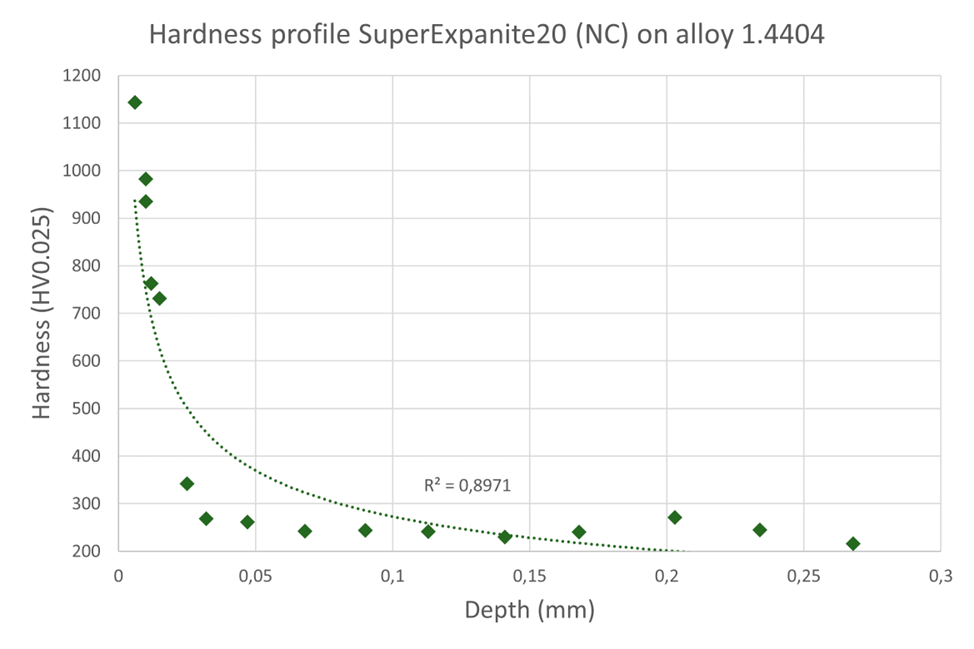
By combining the two process steps, the so-called eggshell effect, which occurs in most surface hardening processes, is avoided. This offers a decisive advantage for numerous applications that require improved load bearing capacity. The hardness profile can be seen in Figure 3.
Fig. 2: Micrograph of expanded austenite layer created with ExpaniteLow-T process (as a part of SuperExpanite product) on AISI 316L alloy.
Fig. 3: Hardness profile of AISI 316L. Below the extremely wear-resistant surface layer (produced in the ExpaniteLow-T process, approx. 1.200 HV) lies a medium-hard transition layer (250-300 HV), which is created in the ExpaniteHigh-T process. Power curve fitted for visual aid.
Wear resistance
To test wear resistance, Expanite tested some 316L samples hardened using its SuperExpanite® process to ASTM standard G 133. In this procedure (see Fig. 4), the SuperExpanite® treated test specimen is subjected to the reciprocating motion of 100Cr6 counterpart, under a contact pressure of 25N. The wear volume is determined after a sliding distance of 100 meters. The results are shown in Fig.: 2. The 316L sample with SuperExpanite® is 125 times more abrasion-resistant than the untreated sample.
Fig. 4: Wear measurement according to ASTM G133
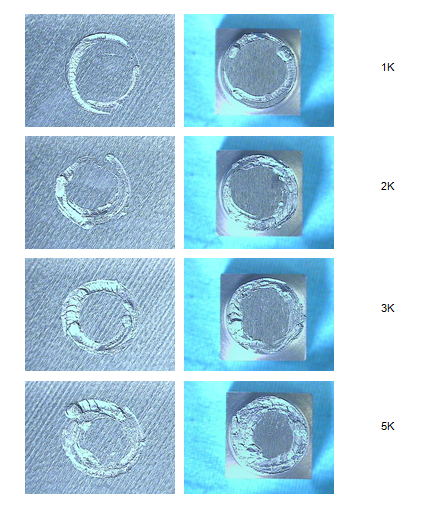
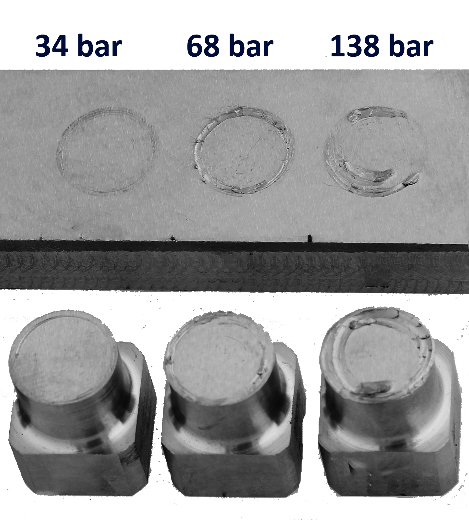
Following the ASTM G133, an ASTM G98 galling test (cold wear) was carried out with test specimens made of AISI 316L, the results of which are shown in Figures 5 and 6. In comparison to the unhardened test specimens, which already exhibit galling at a contact pressure of 35 bar, the test specimens hardened with SuperExpanite® do not show any galling even at a contact pressure of 2758 bar. Even though the first plastic deformations occur at this pressure due to the yield strength being exceeded. The risk of galling is therefore eliminated in the case of both friction partners being hardened.
Fig. 5: Untreated AISI 316L test specimens after ASTM G98
Fig. 6: SuperExpanite treated AISI 316L test specimens after ASTM G98
Corrosion resistance
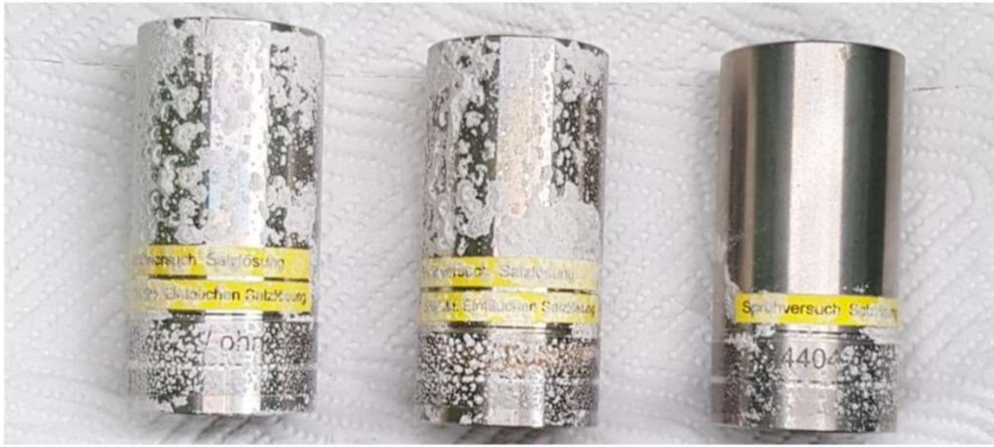
Although the basic intention of conventional surface hardening processes is to produce harder surfaces, this is usually at the expense of corrosion resistance. This is where the Expanite process comes in. Tests have shown that 316L samples hardened with SuperExpanite® can spend up to 1,000 hours in a salt spray chamber without showing signs of corrosion (see figure 7).
Fig. 7.: Results of the salt spray test on SuperExpanite hardened 316L alloy part (far right) as compared to competitors’ solutions
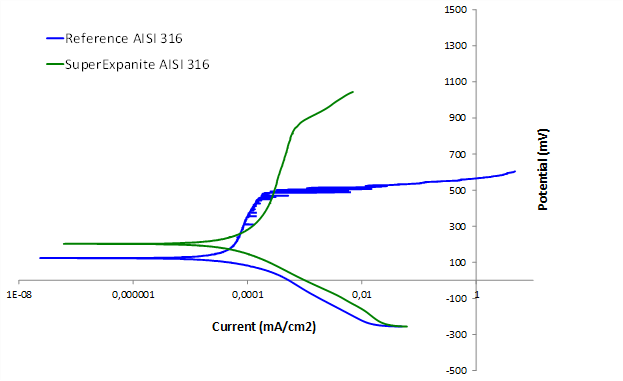
In some cases, the pitting corrosion resistance can even be significantly increased by the Expanite surface hardening process, even beyond the level of the unhardened base material. (Fig. 8). This effect is caused mainly by the large amount of nitrogen dissolved in the surface layer. A common formula for calculating the pitting resistance equivalent number (PREN) for alloys not containing tungsten, is given below (Eq. 1). It is easy to notice a relatively large 16x modifier in front of the nitrogen content expressed in weight percent (wt. %). This means that even small amounts of nitrogen have a significant positive influence on pitting resistance.
Eq. 1: PREN = %Cr + (3.3 x %Mo) + (16 x %N)
With the assumption of applicability of eq. 1 for large amounts of dissolved nitrogen [1], usually between 5 and 13 wt% [2], the PREN number can be calculated. For the AISI 316L alloy the calculated PREN numbers then range from around 100 even up to 230. A minimum of 4-fold increase over untreated material which has a PREN number of around 24. The underlying ExpaniteHigh-T zone can be characterized with PREN number of around 30, providing additional improvement even if the case hardening have been damaged or worn down.
A potentiodynamic polarization curve for SuperExpanite treated and reference AISI 316 material is shown in Figure 8. This test is a common tool used to evaluate the pitting corrosion potential and characteristics of a metal. There are several highlights that can be derived from the graph, showing the undeniable positive influence of SuperExpanite treatment on the pitting corrosion resistance of austenitic alloys.
Firstly, the open circuit potential of SuperExpanite treated sample is around 100mV higher than for the reference, suggesting better corrosion resistance in the absence of galvanic coupling. The polarization curve of the reference material also shows a much narrower passive region, that is characterized with many intermittent peaks (rugged line). Those lines indicate a sudden increase in current density (increased corrosion rate) and subsequent repassivation – initial pit formation. The plot obtained for SuperExpanite sample is free of those irregularities, and the material stays in the passive zone for potentials almost twice as large, with much more gradual decline towards the breakdown potential.
Fig. 8: Pitting resistance of AISI 1.4401 in seawater
Environmentally friendly
Despite their widespread use, conventional surface layer hardening processes have various disadvantages. Harmful chemicals such as fluorides, chlorides, molten salts etc. are used. SuperExpanite®, on the other hand, which is produced using the two-stage process described above, is characterized by an environmentally conscious approach. Without the use of harmful chemicals, and no polluted wastewater Expanite represents an environmentally friendly and sustainable alternative.
Summary
To summarize, the nitrocarburizing process specially developed by Expanite delivers excellent results in terms of both hardness and corrosion resistance for all stainless steel materials, not just limited to individual alloys. The process is therefore recommended for all types of stainless steel screws and fittings to extend the service life of the corresponding components and thus ensure increased product safety and interchangeability.
About Expanite
Expanite is a Danish company specializing in heat treatment and surface hardening of stainless steel and titanium. Expanite has established itself as a pioneer and trusted partner in the industry. The sustainable and patented surface hardening processes improves galling, wear and corrosion resistance on stainless steel and titanium parts in a wide range of applications and industries
The company has its head office in Hillerød near Copenhagen and service centers and licensees in the USA, Germany, Korea, and China. Expanite’s DNA is based on sustainable solutions to extend the life of components made of stainless steel, titanium, and other high-value alloys – and the business model allows for license agreements whereby customers may implement the technology in their production lines. www.expanite.com.
We do not have any open positions right now, you are always welcome to send us an unsolicited application. Please send your application directly clicking below.