Passa al contenuto principale

Venite a trovarci alla fiera: PackExpo 2026

Data: 18-21 ottobre 2026 - Luogo: Chicago, Illinois, Stati Uniti

Partecipa ai nostri webinar gratuiti sull'indurimento superficiale

Autore: Mia

Expanite stabilisce nuovi standard con dati LCA verificati (Articolo in inglese)

As the first company in the surface hardening and heat treatment industry, Expanite has completed an independently verified Life Cycle Assessment (LCA) that documents the environmental footprint of its hardening technologies. The results confirm what Expanite has long claimed that its processes have a low climate impact thanks to a low CO2 footprint and no use of toxic materials.

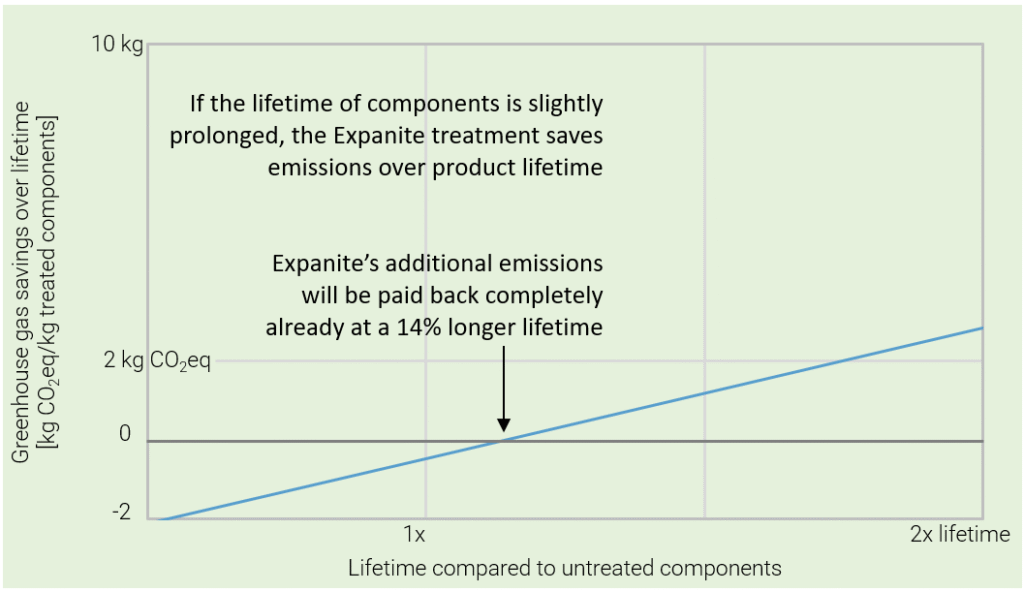
The findings of the LCA were very positive. The climate impact of Expanite’s processes on stainless steel surface hardening leads to only 0,23-0.46 kg CO2 eq per kg of treated material. When compared to the 10.5 kg CO2 eq/kg emissions of untreated stainless steel, the Expanite process adds only 2-14% of greenhouse gas emissions. This very low impact justifies investing or switching to Expanite is environmentally responsible and economically sound. The LCA documents that the Expanite processes are free from fluoride, hydrochloric acid and/or cyanides. The processes generate no toxic waste and, perhaps even more importantly, do not use solvents. The soot emissions from the Expanite processes are so low that there are no health risks. All Expanite sites are fully compliant with local and national environmental standards.


Expanite interviene alla IMAT 2025

Expanite invited to speak at IMAT

Date: Thursday, October 23, 2025: 11:50 AM
Locations: 140G (Huntington Place Convention Center)

Our CTO Thomas Strabo Hummelshøj will be speaking about the subject “Low-temperature stainless steel & Titanium surface hardening” – lead more here

 

Expanite Webinar

Key elements of sustainable surface hardening

Nel nostro webinar avrete l’opportunità di scoprire il processo brevettato di indurimento superficiale Expanite

  • Riduzione dell’usura, del grippaggio e della corrosione
  • Prolungamento della durata dei componenti critici
  • Indurimento superficiale sostenibile
  • Tempi di lavorazione brevi e flessibili

Lingua: inglese – tedesco – italiano – francese. Iscriviti qui sotto:

Webinar: Expanite surface hardening and heat treatment

Lingua: inglese

Data: 5 novembre, ore 10:00 (CET)

Webinaire : Durcissement de surface et traitement thermique Expanite

Lingua: francese

Data: 16 ottobre, ore 11:00 (CET)

Webinar: Oberflächenhärtung und Wärmebehandlung mit Expanite

Lingua: tedesco

Data: 5 novembre, ore 15:00 (CET)

Webinar: Joint Werz & Expanite

Lingua: tedesco

Data: 6 novembre, ore 10:00 (CET)


Rimanete sintonizzati qui o seguiteci su LinkedIn per gli ultimi aggiornamenti e gli inviti.


Newsletter Q4/2024 

Un anno di crescita, innovazione e sostenibilità: highlight di Expanite del 2024

“Mentre si conclude il 2024, vorrei soffermarmi un attimo a riflettere sull’anno che stiamo per lasciare e condividere uno sguardo all’entusiasmante anno che ci attende. Il 2024 è stato un anno straordinario per la nostra azienda; in un contesto industriale in bilico sulla recessione e sfidato da una bassa crescita, Expanite è stata nuovamente in grado di crescere in modo significativo nelle nostre tre regioni di riferimento: Asia, Nord America ed Europa. Superare il mercato e la concorrenza significa che sempre più clienti si affidano alle soluzioni sostenibili di Expanite per i loro componenti di valore. La nostra crescita è stata possibile solo grazie alla continua fiducia dei clienti esistenti e fedeli e all’aggiunta di nuovi clienti: siamo molto grati per questo, mentre continuiamo a migliorare.    Alcuni altri punti salienti del 2024:
    • Abbiamo effettuato investimenti significativi in nuove attrezzature in Nord America, non solo aumentando la capacità, ma anche aggiungendo la nostra tecnologia ExpaniteHard-Ti per l’indurimento del titanio al centro di trattamento statunitense.
    • Abbiamo tenuto più di 20 webinar, che hanno attirato più di 300 partecipanti da tutto il mondo, e abbiamo presentato con orgoglio Expanite in occasione di fiere internazionali in Europa, Nord America e Asia.
    • Abbiamo completato la nostra valutazione del ciclo di vita (LCA), condotta da esperti indipendenti, che documenta l’impronta di carbonio e chimica dei processi di Expanite. Riteniamo di essere i primi nel settore dei trattamenti termici a offrire un LCA ai nostri clienti e partner e, così facendo, offriamo dati imparziali. Per Expanite, la sostenibilità è sempre stata parte del nostro DNA, e ora abbiamo il coraggio di approfondire l’argomento.

Newsletter Q3/2024

Aggiornamenti d’autunno: La crescita di Expanite, gli sforzi per la sostenibilità e gli eventi più importanti

Con l’avvicinarsi dell’autunno, Expanite sta vivendo sviluppi interessanti che siamo ansiosi di condividere con voi. In questa newsletter scoprirete la nostra importante espansione presso le nostre sedi statunitensi per aumentare la capacità produttiva e soddisfare la crescente domanda dei clienti. Conoscerete anche Peter Gundel, il nostro metallurgista con oltre 35 anni di esperienza, ed esplorerete le nostre iniziative di sostenibilità, per ridurre l’impatto ambientale nel settore dell’indurimento delle superfici. Inoltre, diamo il benvenuto a un nuovo membro, Brandon Zembrodt del team americano, e speriamo di vedervi alle prossime fiere come PackExpo a Chicago e Elmia in Svezia quest’autunno! Buona lettura e restate sintonizzati per ulteriori notizie da Expanite! Buona lettura e rimanete sintonizzati per altre novità da Expanite!
Newsletter Q3/2024 Expanite

Newsletter Q2/2024

Risultati eccezionali nei test di resistenza al grippaggio grazie all’indurimento SuperExpanite su acciaio inossidabile martensitico

Galling Test
I materiali di alta qualità richiedono soluzioni di prima classe.  In base ai risultati del test standardizzato di resistenza all’usura ASTM 98, il processo di indurimento superficiale SuperExpanite mostra risultati eccezionali sull’acciaio inossidabile martensitico 1.4021. Questo dimostra che Expanite offre soluzioni superiori per migliorare la resistenza all’usura dell’acciaio inossidabile.

Newsletter Q1/2024 (Disponibile in inglese)

Declaration of compliance for metallic food contact material

Expanite surface hardening on stainless steel passes critical test for repeated food contact with exceptional results. Superior wear resistance can now be combined with safety in relation to food contact.

Do toxic chemicals have a place in the food & beverage industry?

Hard chrome plating has been around for approximately 100 years and this age-old technology requires a number of highly toxic chemicals including hexavalent chromium, a substance of very high concern under European REACH regulation. More and more producers in the F&B industry are switching to Expanite because they are concerned about regulations, they focus on environmental responsibility, and they focus on safety. Join the movement.
Ensuring food safety

Miglioramento della resistenza al grippaggio nei collegamenti a vite in acciaio inox

Galling can be favored by various aspects, such as insufficient surface hardness, excessive roughness, or lack of lubricants. Nevertheless, fasteners are essential in many applications to allow for particularly frequent assembly and disassembly, or high tightening torques. It is therefore important to carefully tailor the properties of such elements. When fasteners are jammed due to galling, their removal can turn out to be an enormous challenge, especially if it needs to be done without damaging the affected bolt or destroying the associated nut.
Fig.1: Generic image of a cold-welded screw connection
Surface hardening, a process in which only the surface layer (few to tens of microns) of a workpiece is hardened, has been proven to significantly improve the seizure behavior of stainless steel screws (Figure 1). The diffusion-based process increases the hardness of the surface through solid solution hardening and subsequently reduces its susceptibility to plastic deformation. Depending on the material, the corrosion resistance is maintained or even improved, and the stiffness of the base material is not impaired. Surface hardening is not an applied coating, but a diffusion-based thermo-chemical surface hardening process. Although classic processes for the surface hardening of corrosion-resistant stainless steels have been available to the industry for some time, their application has two main disadvantages: firstly, all classic processes such as salt bath processes are known to reduce corrosion resistance. On the other hand, the hardness values of stainless steels usually hardened with nitrogen or carbon drop very quickly, i.e. the hardening depth is only a few micrometers and the underlying base material is very soft, which can potentially lead to the egg-shell effect. In contrast, Expanite has developed its proprietary technology (SuperExpanite®) having solved those shortcomings as a priority. With our technological process not only the outermost layer but also the underlying material is hardened to a greater depth which also contributes to an improvement in corrosion resistance in many cases. In many cases, a two-stage process is used in the Expanite’s treatment for stainless steels, in which nitrogen is introduced deep into the surface area in the first step called ExpaniteHigh-T (high-temperature process), whereby the material is hardened to approximately 300 HV for austenitic materials and 850 HV for alloys with martensitic structure to a depth of up to 1 mm. In the second process step, ExpaniteLow-T (low-temperature process, see micrograph in Figure 2), the workpiece is heated to temperatures below 500°C and the surface layer is hardened to 1100-1300HV at a hardening depth of 5-30µm (depending on the solution). The hardening is achieved by incorporating large amounts of interstitial carbon and nitrogen. By combining the two process steps, the so-called eggshell effect, which occurs in most surface hardening processes, is avoided. This offers a decisive advantage for numerous applications that require improved load bearing capacity. The hardness profile can be seen in Figure 3.
Fig. 2: Micrograph of expanded austenite layer created with ExpaniteLow-T process (as a part of SuperExpanite product) on AISI 316L alloy.
Fig. 3: Hardness profile of AISI 316L. Below the extremely wear-resistant surface layer (produced in the ExpaniteLow-T process, approx. 1.200 HV) lies a medium-hard transition layer (250-300 HV), which is created in the ExpaniteHigh-T process. Power curve fitted for visual aid.
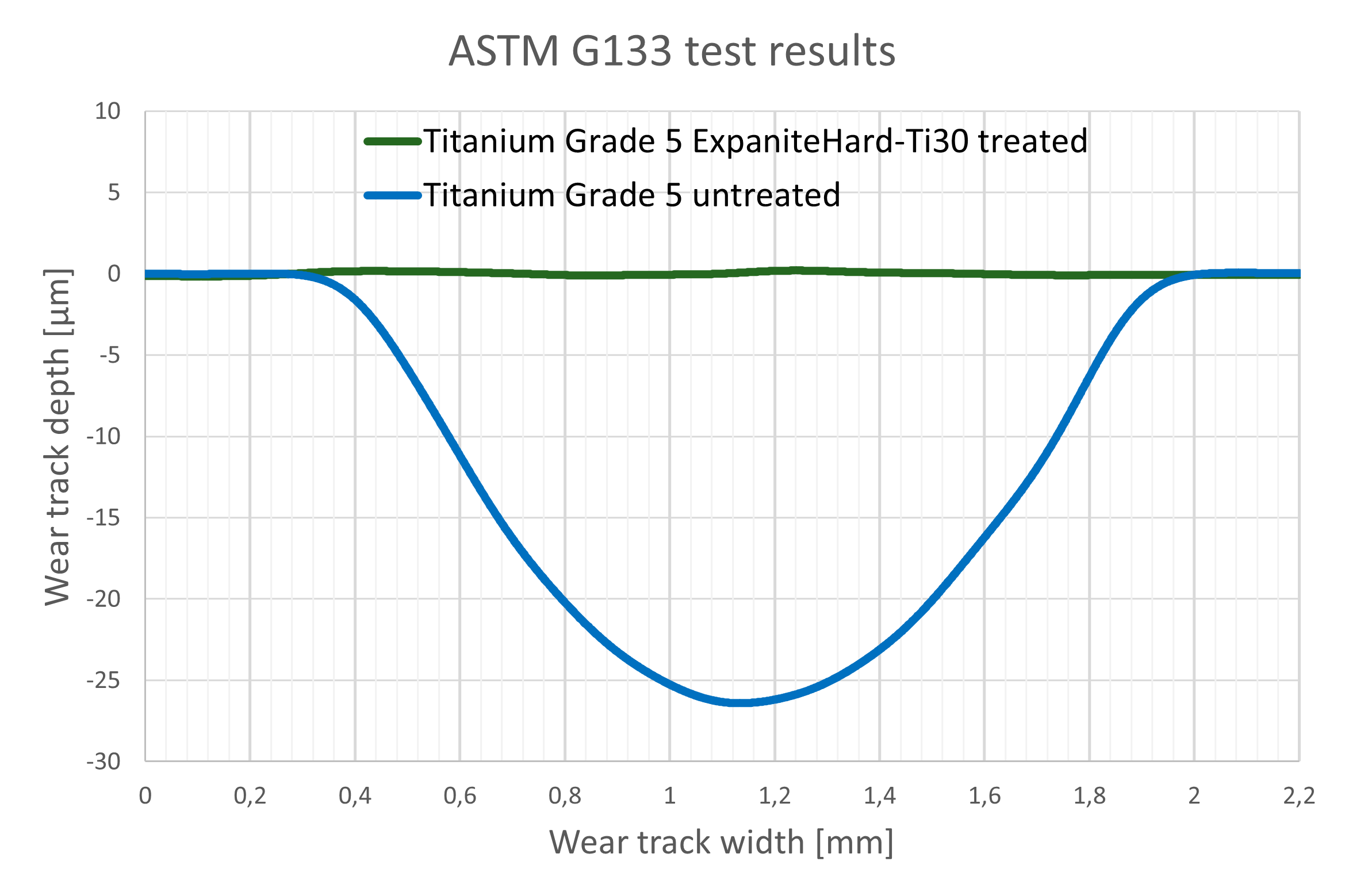
To test wear resistance, Expanite tested some 316L samples hardened using its SuperExpanite® process to ASTM standard G 133. In this procedure (see Fig. 4), the SuperExpanite® treated test specimen is subjected to the reciprocating motion of 100Cr6 counterpart, under a contact pressure of 25N. The wear volume is determined after a sliding distance of 100 meters. The results are shown in Fig.: 2. The 316L sample with SuperExpanite® is 125 times more abrasion-resistant than the untreated sample.
Fig. 4: Wear measurement according to ASTM G133
Following the ASTM G133, an ASTM G98 galling test (cold wear) was carried out with test specimens made of AISI 316L, the results of which are shown in Figures 5 and 6. In comparison to the unhardened test specimens, which already exhibit galling at a contact pressure of 35 bar, the test specimens hardened with SuperExpanite® do not show any galling even at a contact pressure of 2758 bar.  Even though the first plastic deformations occur at this pressure due to the yield strength being exceeded. The risk of galling is therefore eliminated in the case of both friction partners being hardened.
Fig. 5: Untreated AISI 316L test specimens after ASTM G98
Fig. 6: SuperExpanite treated AISI 316L test specimens after ASTM G98
Although the basic intention of conventional surface hardening processes is to produce harder surfaces, this is usually at the expense of corrosion resistance. This is where the Expanite process comes in. Tests have shown that 316L samples hardened with SuperExpanite® can spend up to 1,000 hours in a salt spray chamber without showing signs of corrosion (see figure 7).
Fig. 7.: Results of the salt spray test on SuperExpanite hardened 316L alloy part (far right) as compared to competitors’ solutions
In some cases, the pitting corrosion resistance can even be significantly increased by the Expanite surface hardening process, even beyond the level of the unhardened base material. (Fig. 8). This effect is caused mainly by the large amount of nitrogen dissolved in the surface layer. A common formula for calculating the pitting resistance equivalent number (PREN) for alloys not containing tungsten, is given below (Eq. 1). It is easy to notice a relatively large 16x modifier in front of the nitrogen content expressed in weight percent (wt. %). This means that even small amounts of nitrogen have a significant positive influence on pitting resistance.

Eq. 1: PREN = %Cr + (3.3 x %Mo) + (16 x %N)

With the assumption of applicability of eq. 1 for large amounts of dissolved nitrogen [1], usually between 5 and 13 wt% [2], the PREN number can be calculated. For the AISI 316L alloy the calculated PREN numbers then range from around 100 even up to 230. A minimum of 4-fold increase over untreated material which has a PREN number of around 24. The underlying ExpaniteHigh-T zone can be characterized with PREN number of around 30, providing additional improvement even if the case hardening have been damaged or worn down. A potentiodynamic polarization curve for SuperExpanite treated and reference AISI 316 material is shown in Figure 8. This test is a common tool used to evaluate the pitting corrosion potential and characteristics of a metal. There are several highlights that can be derived from the graph, showing the undeniable positive influence of SuperExpanite treatment on the pitting corrosion resistance of austenitic alloys. Firstly, the open circuit potential of SuperExpanite treated sample is around 100mV higher than for the reference, suggesting better corrosion resistance in the absence of galvanic coupling. The polarization curve of the reference material also shows a much narrower passive region, that is characterized with many intermittent peaks (rugged line). Those lines indicate a sudden increase in current density (increased corrosion rate) and subsequent repassivation – initial pit formation. The plot obtained for SuperExpanite sample is free of those irregularities, and the material stays in the passive zone for potentials almost twice as large, with much more gradual decline towards the breakdown potential.
Fig. 8: Pitting resistance of AISI 1.4401 in seawater
Despite their widespread use, conventional surface layer hardening processes have various disadvantages. Harmful chemicals such as fluorides, chlorides, molten salts etc. are used. SuperExpanite®, on the other hand, which is produced using the two-stage process described above, is characterized by an environmentally conscious approach. Without the use of harmful chemicals, and no polluted wastewater Expanite represents an environmentally friendly and sustainable alternative. To summarize, the nitrocarburizing process specially developed by Expanite delivers excellent results in terms of both hardness and corrosion resistance for all stainless steel materials, not just limited to individual alloys. The process is therefore recommended for all types of stainless steel screws and fittings to extend the service life of the corresponding components and thus ensure increased product safety and interchangeability.