
SuperExpanite® previene il grippaggio delle connessioni a vite in acciaio inossidabile (articolo in inglese)
Corrosion-resistant stainless steel is widely used in industry and trade due to its outstanding properties. Despite its numerous advantages, particularly its resistance to corrosion in numerous media, stainless steel also has considerable weaknesses that sometimes severely limit its application. One of these weaknesses is its susceptibility to cold welding or galling, which can occur particularly with screw connections. Surface hardening offers a solution to this problem.
Galling on stainless steel
Galling can be favored by various aspects, such as insufficient surface hardness, excessive roughness or lack of lubricants. Nevertheless, fasteners are essential in many applications to ensure particularly frequent assembly and disassembly, or high tightening torques. It is therefore important to carefully adjust the properties of such elements. Galling can be favored by various aspects, such as insufficient surface hardness, excessive roughness or lack of lubricants. Nevertheless, fasteners are essential in many applications to ensure particularly frequent assembly and disassembly, or high tightening torques. It is therefore important to carefully adjust the properties of such elements. When fasteners are jammed due to galling, their removal can be an enormous challenge without damaging the affected bolt or destroying the associated nut.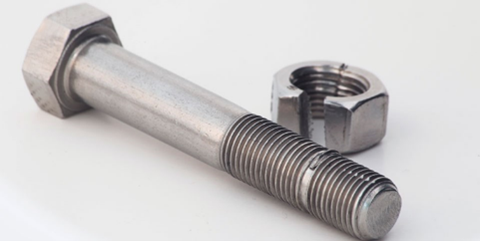
Surface hardening: the key to the solution
Surface hardening, a process in which only the surface layer of a workpiece is hardened, has the potential to significantly improve the seizure behavior of stainless steel screws. This diffusion-based process increases the hardness of the surface through solid solution hardening and reduces its susceptibility to plastic deformation. Depending on the material, the corrosion resistance is maintained or improved and neither the stiffness nor the ductility of the base material is impairedThe Process
Surface hardening is not an applied coating, but a diffusion-based thermo-chemical surface hardening process. Although classic processes for the surface hardening of corrosion-resistant stainless steels have been available to the industry for some time, their application has two main disadvantages: firstly, all classic processes such as On the other hand, the hardness values of stainless steels usually hardened with nitrogen or carbon drop very quickly, i.e. the hardening depth is only a few micrometres and the underlying base material is very soft, which can potentially lead to the egg-shell effect. In contrast, Expanite has developed its process (SuperExpanite®), in which not only the outermost layer but also the underlying material is hardened to a greater depth which also contributes to an improvement in corrosion resistance in many cases. In many cases, a two-stage process is used in the Expanite treatment for stainless steels, in which nitrogen is introduced deep into the edge zone in the first step (high-temperature process), whereby the material is hardened to approx. 300 HV (austenitic materials)-850 HV (martensitic materials) by up to 1 mm. In the second process step, the so-called low-temperature process, the workpiece is heated to a maximum of 470°C and the surface layer is hardened to 1100-1,300HV at a depth of 5-30µm by incorporating carbon and nitrogen (see Fig. 2). By combining the two process steps, the so-called eggshell effect, which occurs in most surface hardening processes, can be avoided, which offers the decisive advantage for numerous applications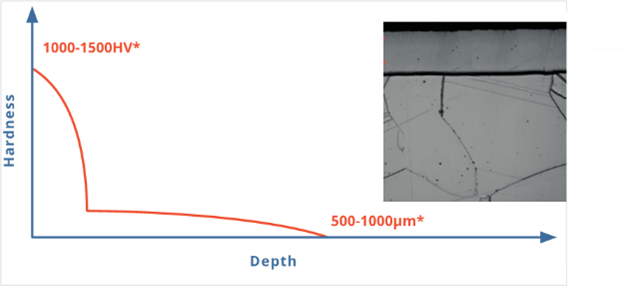
Wear resistance
To test wear resistance, Expanite tested some 316L samples hardened using its SuperExpanite® process to ASTM standard G 98. In this procedure (see Fig. 3), a ceramic test specimen is subjected to a contact pressure of 25N and moved back and forth on a test specimen. The wear volume is determined after a sliding distance of 100 meters. The results are shown in Fig. 2: The 316L sample with SuperExpanite is more resistant to abrasion by a factor of 125 than the untreated sample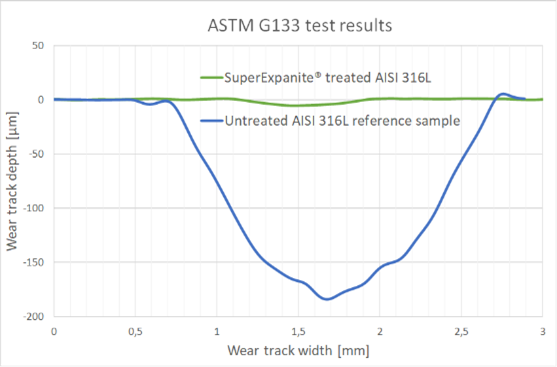
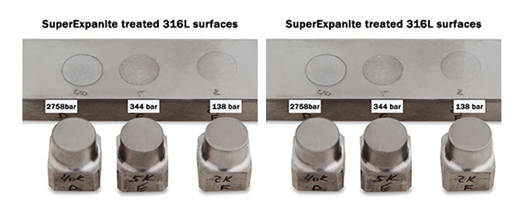
Wear resistance
Although the basic intention of conventional surface hardening processes is to produce harder surfaces, this is usually at the expense of corrosion resistance. This is where the Expanite process comes in. Tests have shown that 316L samples hardened with Expanite can spend up to 1,000 hours in a salt spray chamber without showing signs of corrosion. In some cases, the corrosion resistance can even be significantly increased by the Expanite surface hardening process, even beyond the level of the unhardened base material. (Fig. 5). This effect is caused in particular by the nitrogen dissolved in the surface layer.Environmentally friendly
Despite their widespread use, conventional surface layer hardening processes have various disadvantages. Harmful chemicals such as fluorides, chlorides, molten salts etc. are used. SuperExpanite® , on the other hand, which is produced using the two-stage process described above, is characterized by a resource-saving approach. No natural resources are consumed, and no polluted wastewater is produced. With a low energy consumption of just 1.9 kWh/kg of hardened stainless steel and without the use of harmful chemicals, it represents an environmentally friendly and sustainable alternative.Summary and applications
To summarize, the nitrocarburizing process specially developed by Expanite delivers excellent results in terms of both hardness and corrosion resistance for all stainless steel materials, not just limited to individual alloys. The process is therefore recommended for all types of stainless steel screws and fittings to extend the service life of the corresponding components and thus ensure increased product safety and interchangeability.About Expanite
Expanite offers state-of-the-art solutions for surface hardening treatment of stainless steels and titanium. With Expanite’s processes, it is possible to increase the material’s surface hardness tenfold while at the same time maintaining and even increasing its corrosion resistance. Expanite is a global organization with a combined development and production facility near Copenhagen, Denmark, and hardening capacity in both US, Germany, Korea and China. Expanite’s solutions are flexible and can be introduced directly into a customer’s own production line as part of a licensing arrangement. Learn more on www.expanite.com.