
Maggiore resistenza all'usura dei componenti in acciaio inossidabile per applicazioni con idrogeno
(Articolo in inglese)
Hydrogen – whether applied in shipping, steel production, refineries or power-to-x application – it has become the energy source of the future, yet already used in many sectors. Due to its special properties, the hydrogen gas poses several technical challenges for the respective components with which it comes into contact, so that the use of corrosion-resistant stainless steel is essential. This in turn is susceptible to wear and galling and this is exactly where the technology of the Danish pioneer for surface hardening of stainless steel and titanium comes into play.
Sustainably prevent hydrogen embrittlement
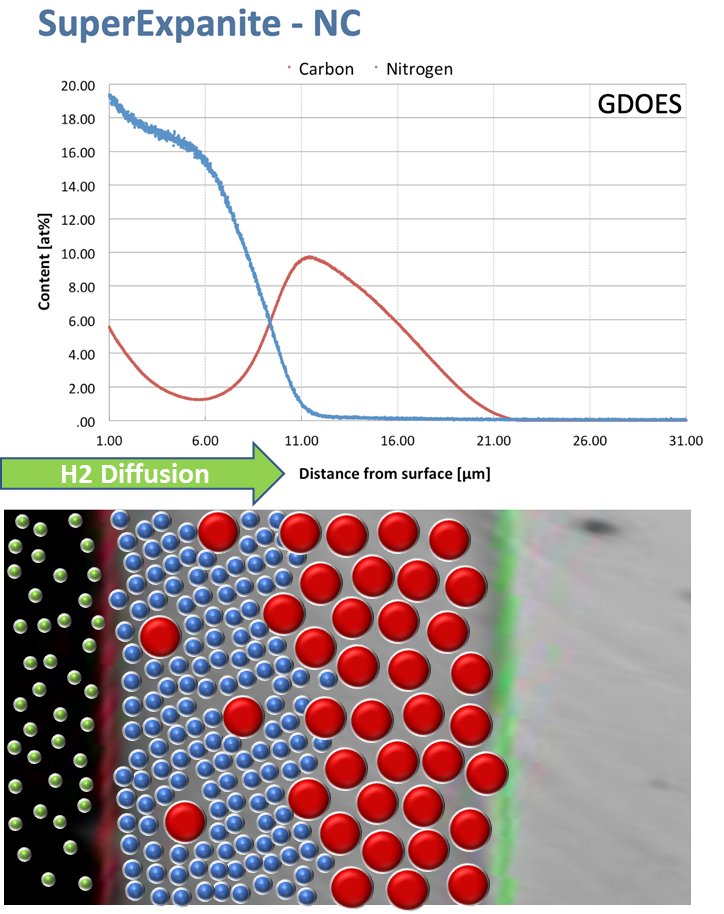
“Our customers often ask whether the Expanite technology increases the risk of hydrogen embrittlement, which is not the case,” explains Dr. Holger Selg, application expert and Expanite Sales Director DACH, who going further into detail: “The cause of the hydrogen embrittlement can be traced back to the diffusion of the hydrogen into the material, and in theory the Expanite layer acts as a diffusion brake to a certain extent. Charged with nitrogen and carbon, the Expanite surface is harder for the hydrogen to penetrate than an untreated surface” The gas-based diffusion process from Expanite is significantly more energy-efficient and environmentally friendly than comparable wear protection processes, and thanks to the treatment in a vacuum, no time-consuming cleaning of the parts, e.g. with aggressive chemicals, is necessary after hardening. The Expanite technology, specially developed for corrosion-resistant materials, offers a solution for austenitic, martensitic, ferritic and duplex stainless steels as well as for expensive nickel-based alloys such as Inconel and Hastelloy. The new special process ExpaniteHard-Ti, which the Expanite team of experts in Denmark has developed to market maturity in recent years, is used for titanium materials.About Expanite
Expanite offers state-of-the-art solutions for surface hardening treatment of stainless steels and titanium. With Expanite’s processes, it is possible to increase the material’s surface hardness tenfold while at the same time maintaining and even increasing its corrosion resistance. Expanite is a global organization with a combined development and production facility near Copenhagen, Denmark, and hardening capacity in both US, Germany, Korea and China. Expanite’s solutions are flexible and can be introduced directly into a customer’s own production line as part of a licensing arrangement.