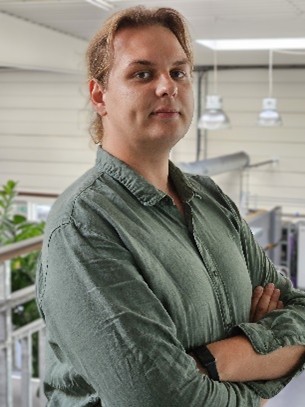
Expanite announced that Frederick Halbout has joined the company as Nordic Sales Manager. In this role, Frederick will be responsible for managing the development of the sales activities in the Nordic market.
Frederick brings many years of experience within international sales and marketing activities and brings extensive knowledge of the Nordic markets to the Expanite team.
Before joining Expanite, Frederick has worked several years at Oerikon Balzers Coating as KAM within Technical Sales and, and has a broad knowledge on surface technology and materials. Frederick knows what it takes to work with clients in a technical market, understand their needs and guide them in the right direction order to find an optimal and/or tailored solution.
Corrosion-resistant stainless steel is widely used in industry and trade due to its outstanding properties. Despite its numerous advantages, particularly its resistance to corrosion in numerous media, stainless steel also has considerable weaknesses that sometimes severely limit its application. One of these weaknesses is its susceptibility to cold welding or galling, which can occur particularly with screw connections. Surface hardening offers a solution to this problem.
Galling on stainless steel
Galling can be favored by various aspects, such as insufficient surface hardness, excessive roughness or lack of lubricants. Nevertheless, fasteners are essential in many applications to ensure particularly frequent assembly and disassembly, or high tightening torques. It is therefore important to carefully adjust the properties of such elements.
Galling can be favored by various aspects, such as insufficient surface hardness, excessive roughness or lack of lubricants. Nevertheless, fasteners are essential in many applications to ensure particularly frequent assembly and disassembly, or high tightening torques. It is therefore important to carefully adjust the properties of such elements. When fasteners are jammed due to galling, their removal can be an enormous challenge without damaging the affected bolt or destroying the associated nut.
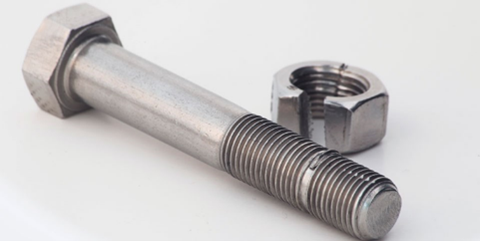
Fig.1: Symbolic image of a cold-welded screw connection
Surface hardening: the key to the solution
Surface hardening, a process in which only the surface layer of a workpiece is hardened, has the potential to significantly improve the seizure behavior of stainless steel screws. This diffusion-based process increases the hardness of the surface through solid solution hardening and reduces its susceptibility to plastic deformation. Depending on the material, the corrosion resistance is maintained or improved and neither the stiffness nor the ductility of the base material is impaired
The Process
Surface hardening is not an applied coating, but a diffusion-based thermo-chemical surface hardening process. Although classic processes for the surface hardening of corrosion-resistant stainless steels have been available to the industry for some time, their application has two main disadvantages: firstly, all classic processes such as On the other hand, the hardness values of stainless steels usually hardened with nitrogen or carbon drop very quickly, i.e. the hardening depth is only a few micrometres and the underlying base material is very soft, which can potentially lead to the egg-shell effect.
In contrast, Expanite has developed its process (SuperExpanite®), in which not only the outermost layer but also the underlying material is hardened to a greater depth which also contributes to an improvement in corrosion resistance in many cases.
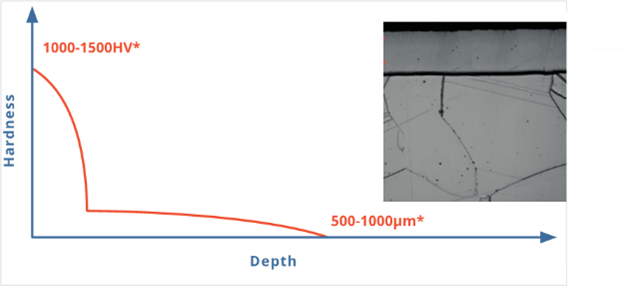
In many cases, a two-stage process is used in the Expanite treatment for stainless steels, in which nitrogen is introduced deep into the edge zone in the first step (high-temperature process), whereby the material is hardened to approx. 300 HV (austenitic materials)-850 HV (martensitic materials) by up to 1 mm. In the second process step, the so-called low-temperature process, the workpiece is heated to a maximum of 470°C and the surface layer is hardened to 1100-1,300HV at a depth of 5-30µm by incorporating carbon and nitrogen (see Fig. 2).
By combining the two process steps, the so-called eggshell effect, which occurs in most surface hardening processes, can be avoided, which offers the decisive advantage for numerous applications
Fig. 2: Micrograph of an AISI 316L material sample; under the extremely wear-resistant surface layer (produced in the “Low-T” process, approx. 1,200 HV) there is a medium-hard transition layer (250-300 HV), which is set in the “High-T” process.
Wear resistance
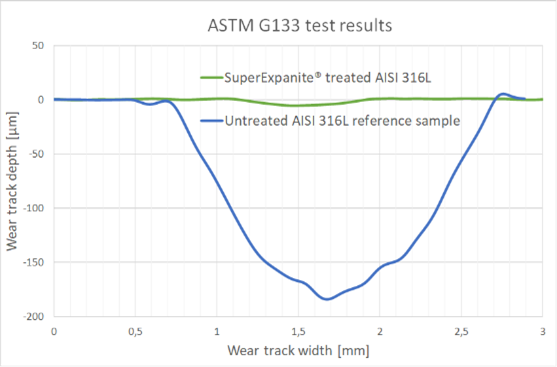
To test wear resistance, Expanite tested some 316L samples hardened using its SuperExpanite® process to ASTM standard G 98. In this procedure (see Fig. 3), a ceramic test specimen is subjected to a contact pressure of 25N and moved back and forth on a test specimen. The wear volume is determined after a sliding distance of 100 meters. The results are shown in Fig. 2: The 316L sample with SuperExpanite is more resistant to abrasion by a factor of 125 than the untreated sample
Fig. 3: Wear measurement according to ASTM G98
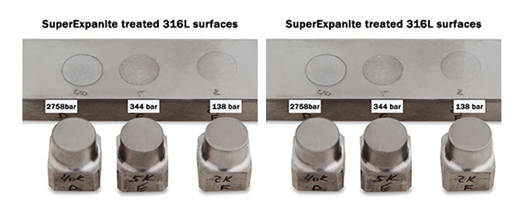
Following ASTM G98, a cold wear test was carried out with test specimens made of 1.4404, the results of which are shown in Figure 4. In comparison to the un-hardened test specimens, which already exhibit galling at a contact pressure of 35 bar, the test specimens hardened by Expanite do not show any galling even at a contact pressure of 2,068 bar – although the first plastic deformations occur due to the yield strength being exceeded. The risk of galling is therefore completely eliminated in the case of both hardened friction partners.
Fig. 4: Test specimens according to ASTM G98 test
Wear resistance
Although the basic intention of conventional surface hardening processes is to produce harder surfaces, this is usually at the expense of corrosion resistance.
This is where the Expanite process comes in. Tests have shown that 316L samples hardened with Expanite can spend up to 1,000 hours in a salt spray chamber without showing signs of corrosion.
In some cases, the corrosion resistance can even be significantly increased by the Expanite surface hardening process, even beyond the level of the unhardened base material. (Fig. 5). This effect is caused in particular by the nitrogen dissolved in the surface layer.
Environmentally friendly
Despite their widespread use, conventional surface layer hardening processes have various disadvantages. Harmful chemicals such as fluorides, chlorides, molten salts etc. are used. SuperExpanite® , on the other hand, which is produced using the two-stage process described above, is characterized by a resource-saving approach. No natural resources are consumed, and no polluted wastewater is produced. With a low energy consumption of just 1.9 kWh/kg of hardened stainless steel and without the use of harmful chemicals, it represents an environmentally friendly and sustainable alternative.
Summary and applications
To summarize, the nitrocarburizing process specially developed by Expanite delivers excellent results in terms of both hardness and corrosion resistance for all stainless steel materials, not just limited to individual alloys. The process is therefore recommended for all types of stainless steel screws and fittings to extend the service life of the corresponding components and thus ensure increased product safety and interchangeability.
About Expanite
Expanite offers state-of-the-art solutions for surface hardening treatment of stainless steels and titanium. With Expanite’s processes, it is possible to increase the material’s surface hardness tenfold while at the same time maintaining and even increasing its corrosion resistance. Expanite is a global organization with a combined development and production facility near Copenhagen, Denmark, and hardening capacity in both US, Germany, Korea and China. Expanite’s solutions are flexible and can be introduced directly into a customer’s own production line as part of a licensing arrangement. Learn more on www.expanite.com.
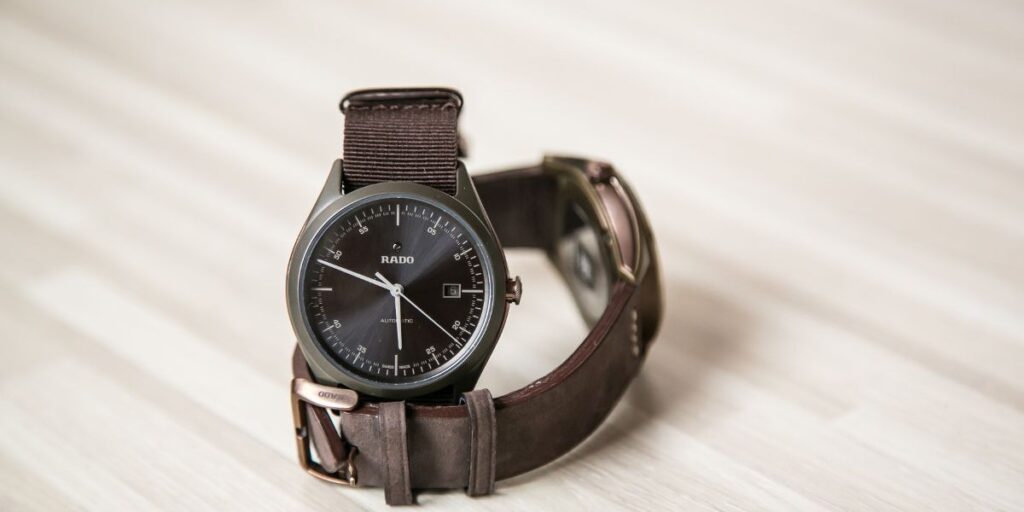
Expanite®, the Danish surface hardening specialist helped the Swiss watch brand Rado® by developing a hardening process to improve wear and scratch resistance on their titanium high-end watches which retains the designed color. This was once thought impossible.
New collections crafted from hardened titanium
Given its strength, titanium is remarkably light. When compared to steel in a strength-to-weight ratio, titanium is far superior, as it is as strong as steel but 45% lighter, and thus a material which is in high demand in mission critical designs for aerospace and high-tech medical applications, among others. Although it is also hypoallergenic and resistant to corrosion, titanium is relatively soft and scratches easily. But not anymore: Rado® unveiled the HyperChrome Ultra Light and Tradition Captain Cook MKIII collections crafted among others from hardened titanium. Where the Tradition Captain Cook MKIII watch has a hardened grade 5 titanium case, the HyperChrome Ultra Light combines high-tech ceramics and hardened titanium in a unique bronze color.
The solution: Expanite treatment offers surface hardness and increased wear and scratch resistance!
The solutions were developed by Expanite®; by using the superior hardening technology “ExpaniteHardTi”. By diffusing molecules into the surface of titanium in a gaseous process, the titanium becomes almost completely resistant to wear and scratches – while keeping the mechanical and corrosion properties, which defines the extraordinary qualities of titanium. ExpaniteHard-Ti is not a coating process, hence all the draws backs of coating including the risks of spalling and inconsistencies in layers are completely avoided. Furthermore, with the ability to harden both titanium grade 2 and grade 5, the process is suitable in a broad range of applications.
“While hardening of the watch case for the Captain Cook MKIII was relative straight forward, the requirements of the HyperChrome Ultra Light designers and development team from Rado® was quite unique; we basically had to redo and upscale a process which we originally thought was faulty. This had some years back yielded titanium grade 5 in a distinct bronze color, while still reaching scratch resistance beyond what had previously been possible with a diffusion-based hardening technique. Our team of experts solved the case and made this part of the HyperChrome Ultra Light watch reality.”, says CEO Thomas Abel Sandholdt from Expanite®.
We’re proud to announce that Expanite has achieved the ISO 14001 certification.
ISO 14001 has become the international standard for designing and implementing an environmental management system. Companies that achieve the certification have proper procedures in place to measure, reduce and manage their environmental impact. Audited by TÜV Nord, one the world’s largest inspection, certification and testing organization, Expanite demonstrated that our environmental management system meets the requirements of ISO 14001.
Improving wear and galling on stainless steel components in hydrogen applications
Hydrogen – whether applied in shipping, steel production, refineries or power-to-x application – it has become the energy source of the future, yet already used in many sectors.
Due to its special properties, the hydrogen gas poses several technical challenges for the respective components with which it comes into contact, so that the use of corrosion-resistant stainless steel is essential. This in turn is susceptible to wear and galling and this is exactly where the technology of the Danish pioneer for surface hardening of stainless steel and titanium comes into play.
In our last newsletter from Q4 2021, we presented a story on how Expanite treatments are used for replacing or reinforcing DLC coatings, in this newsletter we will be talking about how our treatments are replacing fluoroplastic coatings such as Teflon® and Halar® – an underlining of the versatility of Expanite’s solutions.
We’re also happy to present yet another innovative product, where Expanite’s hardening technology for titanium made a difference and added significant value. Check-out the story on the world’s first solid-titanium fountain pen from Capillaris.
Finally, if you – or any of your colleagues, friends, or associates – haven’t already participated in an Expanite webinar, please don’t hesitate to join, new dates are now available. But also, for the first time in several years, Expanite is now exhibiting in the “real” world during 2022, starting out in France, then Germany, moving to the US, and returning to Germany towards the end of the year – we are so much looking forward to each of these events!!
From relocating to Denmark as a child to building a career without formal education but with endless curiosity and persistence, Pityu’s path is anything but ordinary.
Interview
First of all:What is your educational background, and how did you end up at Expanite?
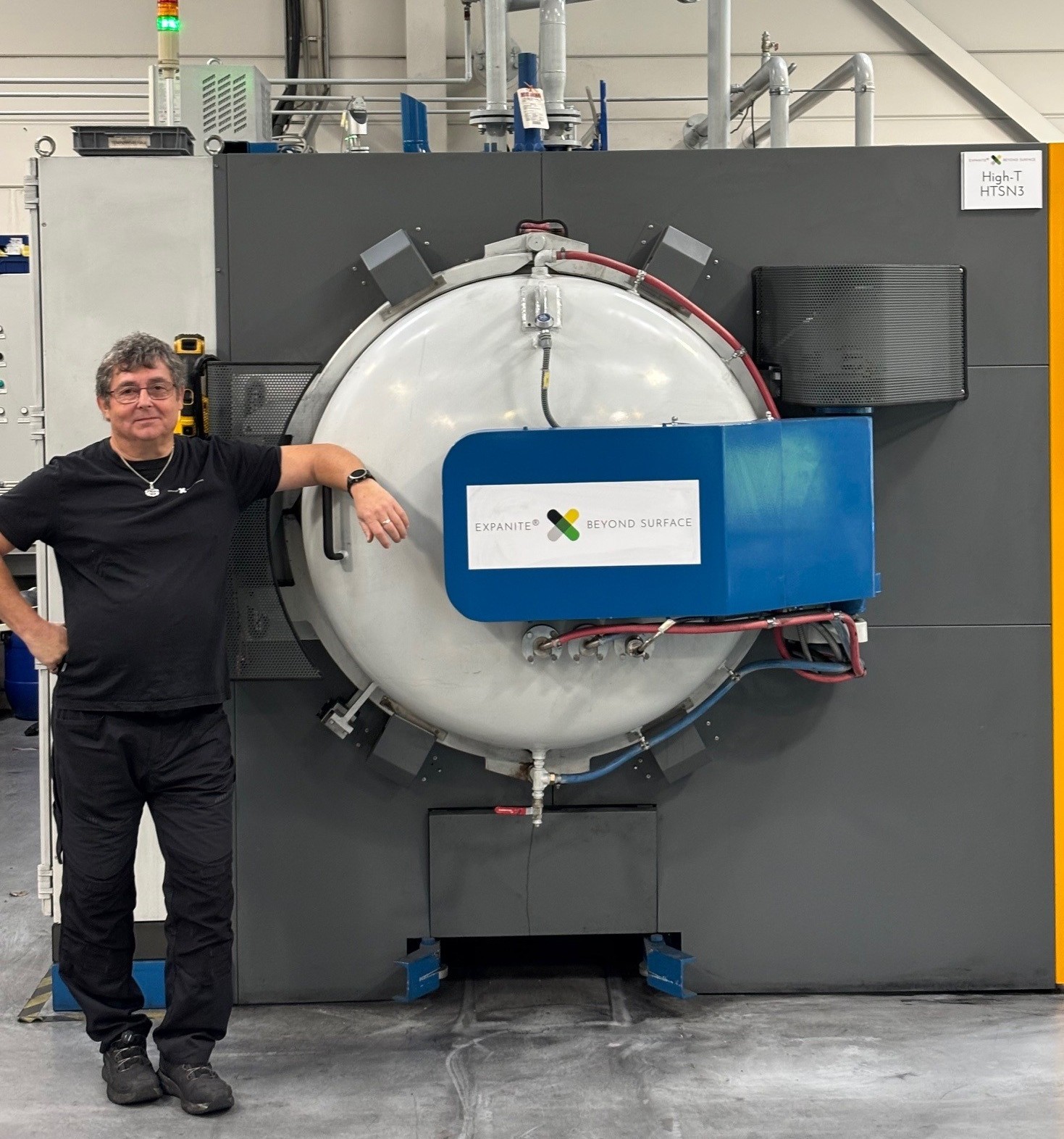
I was born in Hungary, and my parents moved to Denmark when I was a kid. Moving to another country has strengthened my resilience and curiosity. As is probably true for many people, I have worked my way up. What may be different compared to others is that I have no formal education. All my life, I have been curious and wanted to learn new things. This has given me a tremendous insight not only in technologies, processes and people, but I have been fortunate to supplement my “on the job” training with many relevant courses. Looking back, I can safely say that I have always responded to new challenges with the view “I don’t know anything about it, so I am sure I can work it out”. I applied for and got the job as Production Operator at Expanite in 2018. I had been following Expanite for several years because I had worked with the CEO at Expanite, Thomas Sandholdt, when I was head of production at another company. During my first week here at Expanite, the head of production unexpectedly left for another opportunity, and I was asked to take over. We had one week to cover the handover process. This was a bit of a deep-water exercise for me, but I just looked at it and thought, “How difficult can it be?”
Even though I was completely new in the job, Expanite sent me to Germany to help the team there. This experience started a long relationship with our German colleagues. This is a part of my job I enjoy tremendously. And you may ask, why am I still at Expanite? It is the people, the team and the challenges. And the fact that no two days are the same. We have achieved a lot, we have developed a lot, and we continue to optimize, which I truly enjoy.
How would someone who knows you well describe you?
I am more temperamental at home than at Expanite. I hope my family says that I am easy to live with. I am the loyal type. And I am a family man. Even at 4 o’clock in the morning. I hope my colleagues think of me as a person seeking good compromises and involving others.
What’s a day in the life like for you at Expanite?
I arrive at Expanite early in the morning and meet with the production team. I quickly get an overview of what is going on thanks to Fenris, our digital production management platform. Following this, I met with Timo, our German Head of Production. All my days are different, but one thing is sure: I am always curious, and I am always “hands-on” if we have an issue.
What are some of the key technologies and tools you work with at Expanite?
My two main tools are Fenris and our ERP platform, E-conomic. As a member of the management team, I am constantly looking at how to optimise production costs, including reducing handling costs.
Have you noticed any interesting trends or projects within a specific industry?
The biggest achievement is that the production teams in Denmark and Germany are now one entity. We have a common view (thanks to Fenris), and it increases our utilization. Without a structure and a common understanding, you can’t manage, and you can’t optimize. Thanks to the structure, we can help our customers, we can deliver faster, and we ensure a consistent quality.
What are the latest trends or technologies either helping or disrupting our industry?
The future is digital. I know I have mentioned Fenris several times, but it is truly unique that we can manage everything through this platform. For the future, I am pretty sure new and improved analytics tools will emerge. Another opportunity is Heat Treatment with an even shorter turnaround time.
How does the production team at Expanite help our customers?
There is, of course, the actual surface hardening that ultimately makes our customers’ parts more durable and competitive. We in the production team make sure that all parts we receive are handled and processed correctly, and we often advise on protective packaging, ensuring that the parts are transported without scratches or other damage.
How does your work at Expanite impact the company’s overall goals and objectives?
I sincerely hope that what I do contributes to achieving our common goals. My main tasks are to deliver on time, on spec, on quality, using the right processes and the right resources. We are a growth company, and I appreciate that we are working towards a common goal.
What trends do you see in the industry, and how is Expanite preparing for the future?
Sustainability is a mega trend affecting us all. At home and at our jobs, we optimize the use of all resources (electricity, water, etc) and we, of course, sort all our waste (paper, packing, cardboard, etc). Our ISO 14001 is a natural part of this development and a part of our daily work life.
What advice would you give to someone aspiring to work in a technical role at a company like Expanite?
First of all, I would wish them good luck and all the best. I would advise them to be honest, correct and polite. Share your experiences and be helpful. Be ready for changes and support the team. Then it can’t go wrong.
Can you share a memorable experience or accomplishment during your time at Expanite that stands out to you?
Working together and achieving something together is a great feeling. I truly feel that the German and Danish operational team is exactly that: one team. This makes me proud. Another thing that makes me proud is the number of times we reach our goals and deliver on time. That’s a great feeling.
About Expanite
Expanite offers state-of-the-art solutions for surface hardening treatment of stainless steels and titanium. With Expanite’s processes, it is possible to increase the material’s surface hardness tenfold while at the same time maintaining and even increasing its corrosion resistance. Expanite is a global organization with a combined development and production facility near Copenhagen, Denmark, and hardening capacity in both US, Germany, Korea and China. Expanite’s solutions are flexible and can be introduced directly into a customer’s own production line as part of a licensing arrangement. Learn more on www.expanite.com.
Thomas Strabo Hummelshøj, Co-founder and CTO of Expanite, innovator, and the driving force behind the company’s groundbreaking technologies and digital solutions.
Interview
Get to learn the man behind the Expanite technologies and learn how Expanite was born. Read Thomas’ take on why digitalization will play an even bigger role – also when it comes to surface hardening.
Why did you become an engineer?
I guess it is in my DNA. My grandmother worked with the Danish physicist and Nobel prize winner Niels Bohr. Both my parents were physicists. At the university, I studied mathematics and physics, but I quickly changed to DTU (the Technical University of Denmark) and studied technical physics. I wanted to do a PhD, and I met Professor Somers, who for ten years had been working with stainless steel. Professor Somers guided me to a PhD on how stainless steel performs when subjected to carbon. In this way, we discovered, how you can surface harden stainless steel. We founded Expanite as a spin-off from DTU, and like all start-ups, our first office was in the basement, where we had our desks and the oven for surface treatment in the same room. That says something about our low impact treatment solutions. Besides physics, I have studied Sports and taught at high schools for 10 years. I had not planned to start a company – it just happened to be a logical next step.
What is your current role and what are your main responsibilities?
In our first years, some people would call me Mr. Expanite. With our new management structure, our new board, and our strong investors, this doesn’t happen anymore. I have two important roles now: ensure that our engineers and technical team know at least as much as I do. My second role is the continuous development of our digital production platform (Fenris). The fact that we have this platform, and we can manage everything that happens in the ovens, is not only unique but also very powerful.
What is your current role and what are your main responsibilities?
I am a process specialist. I know a thing or two about heat treatment, I understand the processes, and my knowledge about metals doesn’t harm. And over the years, I have developed a strong network, that is always ready to help. I help our customers find the right solutions giving their parts the properties they want. And here at Expanite, I am deeply involved in our technology development program working closely with our technical team
How would someone living with you describe you?
The expression they would use is probably “ultimate”. I believe things must be done right.
What’s a day in the life like for you at Expanite?
My favorite day starts with a bike ride from my home to Expanite north of Copenhagen. I enjoy working with our skilled tech team, and I see my role as being their coach. When I get home in the evening, I would like to think that I have made a difference for the team, and that the team has made a difference for our customers and colleagues.
What are some of the key technologies and tools you work with at Expanite?
These days I work mainly with our proprietary software Fenris. I believe that software is the key to the future. With our software, we can continue to optimize our processes both in terms of the performance of the treated material and in terms of the environmental impact of our processes. I am now much more a physicist and a software guy than a materials man!
Can you describe a recent project you’ve worked on and your contributions to it?
I don’t want to go into specific projects. I would like to stress the power of our digital production platform. Previously, I would travel a lot, managing tests, new developments etc. Now, with our production platform, I can supervise and manage the entire process. I know exactly what’s going on in the oven, what’s happening in the lab. We work and communicate through the same platform, and I am the proud founder of this platform.
What innovative technologies or solutions is Expanite currently developing?
Expanite is increasingly expanding its focus into the realm of traditional heat treatment—a natural progression for us. These advancements, along with several other exciting developments, will soon be launched, and I am eager to see the impact they will have on the industry.
What are some of the biggest technical challenges you face in your work, and how do you overcome them?
It is all about running a streamlined, high quality, low emission process that ensures the quality our customers have come to expect from Expanite. The fine tuning through our digital platform is the way to go.
How does the tech team at Expanite help your customers?
Embedded in our DNA is the willingness to help. Our technical team knows a lot about alloys, and we see ourselves as genuine partners, where transparency is one of our values. Our customers consult us on the use of materials. I believe we have saved our customers a lot of money when we have suggested cheaper alloys that do the job just as good – or better – than the more expensive material, that was originally chosen. The choice of material is sometimes a surprise – I would like to challenge the perception that more expensive materials offer better performance. This is not always the case and with our flexible treatment solutions, there is most often a smarter way. Product development is another area, where we help our customers or the consultancy companies they have hired. Finally, I would like to mention speaking at conferences. I enjoy standing in front of an audience and share our experiences.
What trends do you see in the industry, and how is Expanite preparing for the future?
I like to remove unnecessary steps. And I enjoy optimizing whatever we do. As mentioned, the future is digital. The winners will be those who can control everything digitally. At Expanite, we are at the forefront of this trend.
What advice would you give to someone aspiring to work in a technical role at a company like Expanite?
Be ready to innovate. Be open and curious. When you encounter a challenge think: “I have never done this before, therefore I can do it”. Be ready to criticize what has already been established and be agile and ready to disrupt. I still see Expanite as the new boy in the classroom. Within our team there is a lot of trust. We will use that trust and our eagerness to spread our technologies and solutions to new applications and corners of the world.
Can you share a memorable experience or accomplishment during your time at Expanite that stands out?
The development of SuperExpanite was a milestone. I remember I spent my holiday writing the patent application. Another milestone is the development of our digital production platform enabling us to manage and communicate with the ovens. That was a breakthrough
About Expanite
Expanite offers state-of-the-art solutions for surface hardening treatment of stainless steels and titanium. With Expanite’s processes, it is possible to increase the material’s surface hardness tenfold while at the same time maintaining and even increasing its corrosion resistance. Expanite is a global organization with a combined development and production facility near Copenhagen, Denmark, and hardening capacity in both US, Germany, Korea and China. Expanite’s solutions are flexible and can be introduced directly into a customer’s own production line as part of a licensing arrangement. Learn more on www.expanite.com.
Peter Gundel is our Process Specialist at Expanite located in Hilleroed, Denmark. Peter has +35 years of experience working in heat treatment industry.
Interview
First of all: Why did you become an engineer?
When I walked through the doors of DTU (Technical University of Denmark) I wanted to become a chemical engineer. During my studies, I visited a steel mill and was fascinated by the gigantic steel plates, the heat, the sparks, and following that I took all the courses I could get on metals. I even managed to get a summer job at a heat treatment plant where I started working the day I gave in my master’s thesis. I did my PLD with the same company in laser surfacing.
Can you tell us about your background and how you came to work at Expanite?
Before joining Expanite, I was with one of our competitors for 34 years. Over the years I have been involved in technology development, managing large EU-funded projects, and I had my own blog in the company newsletter – and have been speaking at numerous industry events. The heat treatment plant I worked for was closed, and I spotted the Expanite vacancy in the newspaper. I wrote an application, went for the interview, and got the job in 2022. I later learned that Expanite thought that I had moved to another part of Denmark and therefore was not interested in the job.
Apart from the job at Expanite, I am a censor both at DTU and the University of Aarhus. I keep my skills honed by helping The Danish Accreditation Institution when they assess laboratories.
What is your current role and what are your main responsibilities?
I am a process specialist. I know a thing or two about heat treatment, I understand the processes, and my knowledge about metals doesn’t harm. And over the years, I have developed a strong network, that is always ready to help. I help our customers find the right solutions giving their parts the properties they want. And here at Expanite, I am deeply involved in our technology development program working closely with our technical team
How would someone living with an engineer describe you?
My wife says I am the quiet type. On the other hand, when we play Quiz Planet, everybody wants me on their team. I enjoy hiking, and I hope my friends will confirm that I am a helpful and friendly guy.
What’s a day in the life like for you at Expanite?
Once I have had my morning coffee, I check our digital production platform, that monitors all orders and all processes in all our treatment centers around the world. In case we want to optimize or check the quality, I decide when and how to involve our laboratory. During the day I typically help our sales expert come up with the best solutions for our customers. And I of course work with our own product and process development
What are some of the key technologies and tools you work with at Expanite?
I wouldn’t say it is my favorite book, but the Stahlschlüssel is my go-to guide, when new solutions are required
What are the latest trends or technologies either helping or disrupting your industry?
The trend from combustion engines to EVs is really exciting. EVs also need parts that can operate under tough conditions. The fact that we extend the lifetime of critical components is a contribution to a more circular economy. That is great. I am so pleased that we can now document that the investment in an Expanite treatment easily pays off in environmental terms and that our CO2 footprint is so small.
Can you share a memorable experience or accomplishment during your time at Expanite that stands out to you?
I really like it when we fix things and achieve something, that people say “it can’t be done”. We see a lot of amazing parts from pumps to wind turbine brakes, to implants, to watches. Power-to-X is a new and exciting technology, but also very demanding. It is great when we can help that industry solve their challenges. This is another way we are contributing to a greener world
About Expanite
Expanite offers state-of-the-art solutions for surface hardening treatment of stainless steels and titanium. With Expanite’s processes, it is possible to increase the material’s surface hardness tenfold while at the same time maintaining and even increasing its corrosion resistance. Expanite is a global organization with a combined development and production facility near Copenhagen, Denmark, and hardening capacity in both US, Germany, Korea and China. Expanite’s solutions are flexible and can be introduced directly into a customer’s own production line as part of a licensing arrangement. Learn more on www.expanite.com.
Szymon Stachlewski is one of the Materials and Surface specialist working for Expanite. Simon joined us in 2023 after having completed his degree in materials and surface technology at the leading Technical University of Denmark, DTU.
Interview
First of all:Why did you become an engineer?
I always wanted to be a scientist, working in a white kilt, working in a lab, doing science work. To me, engineering is applied science.
Can you tell us about your background and how you came to work at Expanite
My background is in materials and manufacturing. I finished my studies at DTU, and I ended at Expanite thanks to the fact that during my studies I learned about the company from one of the professors, Prof. Marcel A.J. Somers, who was one of the founders of Expanite when it was established in 2010 as a spin-off from The Technical University of Denmark (DTU). Before landing a permanent position, inspired by his recommendations and connections to Expanite, I tried getting a student job at Expanite, but didn’t get it. One year later there was a job opening, I applied for the job and got it!
What is your current role and what are your main responsibilities?
My job title is Materials and Surface specialist. My task is anything from customer and sales support, helping production, helping marketing, design and order of tools used in production, and I also do R&D. I look over the processes, do trouble shooting, and ensure that our hardware always is in top-notch condition.
How would someone living with an engineer describe you?
I like to think of myself as heartfelt, and a nice person. I am social, but also good at being alone. I am passionate about things I am passionate about. I love to talk about my work and materials science.
What’s a day in the life like for you at Expanite?
I wake up way too late, I rush through my morning routine, and take the bike to work. First, I will have a brief talk with the production manager. Then I respond to mails, support the team members. Additionally, I will make presentations, and provide summaries of the results of my research. After lunch I usually do some lab work. If there are issues in the production, I will spend more time on that.
Can you describe a recent project you’ve worked on and your contributions to it?
There are a lot of projects, the one I would like to mention is the one we did with a company in the luxury accessories category. When their parts were subjected to the Expanite processes we saw some unwanted discoloring. We experimented with various solutions including cleaning, and together with the customer we discovered the source of the problem. After this discovery, and addressing the underlying cause, the finished product looked perfect after our treatment. That was a really nice project where my technical background and good communication could be directly linked to a happy customer.
How does the tech team at Expanite help your customers?
Well, we answer their technical questions, we communicate either directly with the customers or together with the sales team. Helping them find documentation and summarize the results of our findings. We also meet with our customers’ engineering departments – engineers talking to engineers always gives the best results.
How does your work at Expanite impact the company’s overall goals and objectives?
I have two areas of contribution: one is the R&D projects, which will help Expanite close bigger deals. However, on a daily basis I try and be helpful with smaller tasks. Here at Expanite, I want to show that we care about our customers. I will help the customers find the process that is right for them. I always put the customer first and try and anticipate their needs and show we are there to help them in finding the right solution. We are open to testing new ideas, testing new parts, and generally as a company we are very open. It is my strong belief that knowledge sharing is the way forward for our industry, so I always try to do my best in explaining the process.
What trends do you see in the industry, and how is Expanite preparing for the future?
I see the environmental impact as the biggest trend. Whether you are an engineer working on new products, maintaining existing or responsible for purchasing, we are all concerned about the environmental impact of our daily decisions and want to make sure that the solutions we use are safer, greener and more effective. In my view, Expanite checks all these boxes. As a result, I believe we will gain more and more business. We are the greener alternative for surface hardening. And we are faster too.
What advice would you give to someone aspiring to work in a technical role at a company like Expanite?
Have fun, you must like what you do. The job is full of surprises, and you spend a lot of time thinking about it. You have to be passionate about your job.
Why did you decide to stay in Denmark?
I like the society, everything “just works” here, and I feel safe here. It is not as rainy as Danes think. The wind is maybe annoying, it is the only place in the world where you can turn three times to the left and still have the wind in front!
About Expanite
Expanite offers state-of-the-art solutions for surface hardening treatment of stainless steels and titanium. With Expanite’s processes, it is possible to increase the material’s surface hardness tenfold while at the same time maintaining and even increasing its corrosion resistance. Expanite is a global organization with a combined development and production facility near Copenhagen, Denmark, and hardening capacity in both US, Germany, Korea and China. Expanite’s solutions are flexible and can be introduced directly into a customer’s own production line as part of a licensing arrangement. Learn more on www.expanite.com.