
Miglioramento della resistenza al grippaggio nei collegamenti a vite in acciaio inox
(Articolo in inglese)
Corrosion-resistant stainless steel is widely used in industry and trade due to its outstanding properties. Despite its numerous advantages, particularly its resistance to corrosion in numerous media, stainless steel also has considerable weaknesses that sometimes severely limit its application. One of these weaknesses is its susceptibility to cold welding or galling, which can occur particularly with screw connections. Surface hardening offers a solution to this problem.
Galling on stainless steel
Galling can be favored by various aspects, such as insufficient surface hardness, excessive roughness, or lack of lubricants. Nevertheless, fasteners are essential in many applications to allow for particularly frequent assembly and disassembly, or high tightening torques. It is therefore important to carefully tailor the properties of such elements. When fasteners are jammed due to galling, their removal can turn out to be an enormous challenge, especially if it needs to be done without damaging the affected bolt or destroying the associated nut.Surface hardening: the key to the solution

The Process
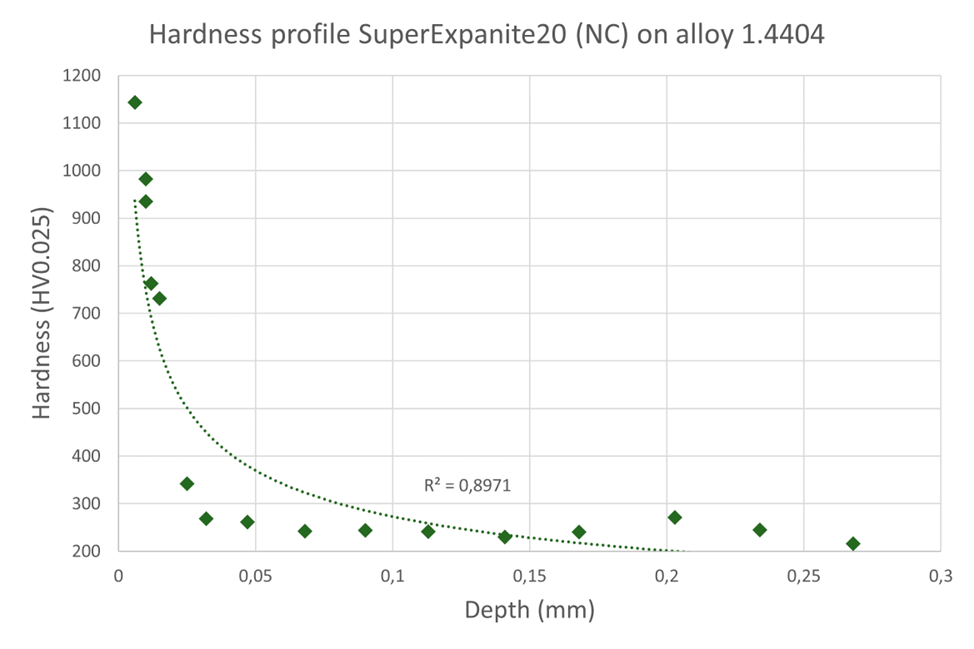
Surface hardening is not an applied coating, but a diffusion-based thermo-chemical surface hardening process. Although classic processes for the surface hardening of corrosion-resistant stainless steels have been available to the industry for some time, their application has two main disadvantages: firstly, all classic processes such as salt bath processes are known to reduce corrosion resistance. On the other hand, the hardness values of stainless steels usually hardened with nitrogen or carbon drop very quickly, i.e. the hardening depth is only a few micrometers and the underlying base material is very soft, which can potentially lead to the egg-shell effect. In contrast, Expanite has developed its proprietary technology (SuperExpanite®) having solved those shortcomings as a priority. With our technological process not only the outermost layer but also the underlying material is hardened to a greater depth which also contributes to an improvement in corrosion resistance in many cases. In many cases, a two-stage process is used in the Expanite’s treatment for stainless steels, in which nitrogen is introduced deep into the surface area in the first step called ExpaniteHigh-T (high-temperature process), whereby the material is hardened to approximately 300 HV for austenitic materials and 850 HV for alloys with martensitic structure to a depth of up to 1 mm. In the second process step, ExpaniteLow-T (low-temperature process, see micrograph in Figure 2), the workpiece is heated to temperatures below 500°C and the surface layer is hardened to 1100-1300HV at a hardening depth of 5-30µm (depending on the solution). The hardening is achieved by incorporating large amounts of interstitial carbon and nitrogen. By combining the two process steps, the so-called eggshell effect, which occurs in most surface hardening processes, is avoided. This offers a decisive advantage for numerous applications that require improved load bearing capacity. The hardness profile can be seen in Figure 3.
Wear resistance
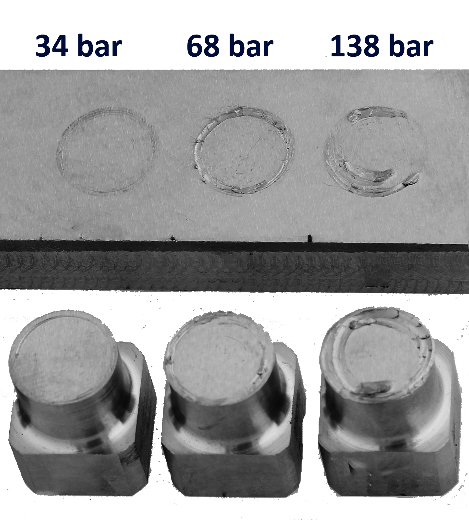
To test wear resistance, Expanite tested some 316L samples hardened using its SuperExpanite® process to ASTM standard G 133. In this procedure (see Fig. 4), the SuperExpanite® treated test specimen is subjected to the reciprocating motion of 100Cr6 counterpart, under a contact pressure of 25N. The wear volume is determined after a sliding distance of 100 meters. The results are shown in Fig.: 2. The 316L sample with SuperExpanite® is 125 times more abrasion-resistant than the untreated sample.

Corrosion resistance
Although the basic intention of conventional surface hardening processes is to produce harder surfaces, this is usually at the expense of corrosion resistance. This is where the Expanite process comes in. Tests have shown that 316L samples hardened with SuperExpanite® can spend up to 1,000 hours in a salt spray chamber without showing signs of corrosion (see figure 7).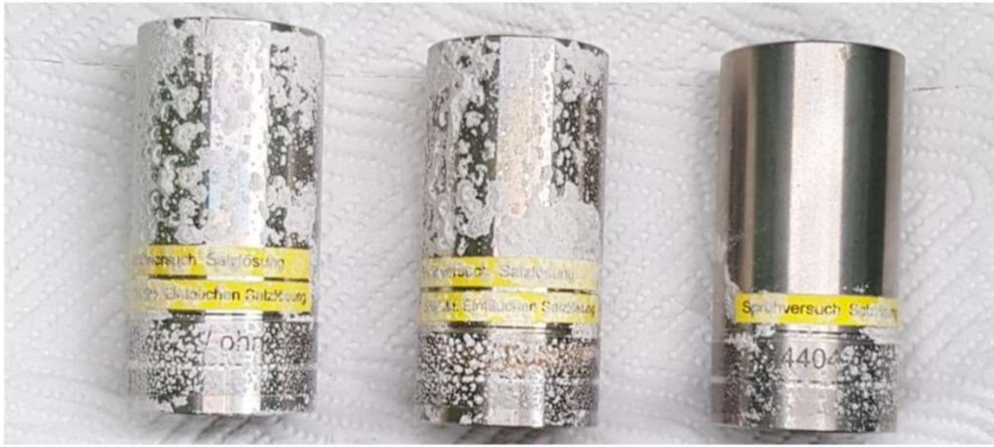
Eq. 1: PREN = %Cr + (3.3 x %Mo) + (16 x %N)
With the assumption of applicability of eq. 1 for large amounts of dissolved nitrogen [1], usually between 5 and 13 wt% [2], the PREN number can be calculated. For the AISI 316L alloy the calculated PREN numbers then range from around 100 even up to 230. A minimum of 4-fold increase over untreated material which has a PREN number of around 24. The underlying ExpaniteHigh-T zone can be characterized with PREN number of around 30, providing additional improvement even if the case hardening have been damaged or worn down. A potentiodynamic polarization curve for SuperExpanite treated and reference AISI 316 material is shown in Figure 8. This test is a common tool used to evaluate the pitting corrosion potential and characteristics of a metal. There are several highlights that can be derived from the graph, showing the undeniable positive influence of SuperExpanite treatment on the pitting corrosion resistance of austenitic alloys. Firstly, the open circuit potential of SuperExpanite treated sample is around 100mV higher than for the reference, suggesting better corrosion resistance in the absence of galvanic coupling. The polarization curve of the reference material also shows a much narrower passive region, that is characterized with many intermittent peaks (rugged line). Those lines indicate a sudden increase in current density (increased corrosion rate) and subsequent repassivation – initial pit formation. The plot obtained for SuperExpanite sample is free of those irregularities, and the material stays in the passive zone for potentials almost twice as large, with much more gradual decline towards the breakdown potential.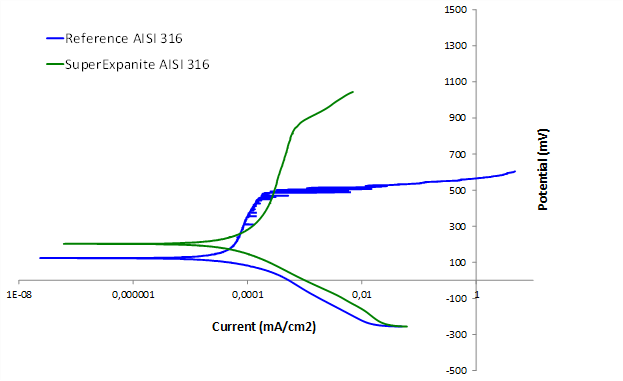
Environmentally friendly
Despite their widespread use, conventional surface layer hardening processes have various disadvantages. Harmful chemicals such as fluorides, chlorides, molten salts etc. are used. SuperExpanite®, on the other hand, which is produced using the two-stage process described above, is characterized by an environmentally conscious approach. Without the use of harmful chemicals, and no polluted wastewater Expanite represents an environmentally friendly and sustainable alternative.Summary
To summarize, the nitrocarburizing process specially developed by Expanite delivers excellent results in terms of both hardness and corrosion resistance for all stainless steel materials, not just limited to individual alloys. The process is therefore recommended for all types of stainless steel screws and fittings to extend the service life of the corresponding components and thus ensure increased product safety and interchangeability.About Expanite
Expanite is a Danish company specializing in heat treatment and surface hardening of stainless steel and titanium. Expanite has established itself as a pioneer and trusted partner in the industry. The sustainable and patented surface hardening processes improves galling, wear and corrosion resistance on stainless steel and titanium parts in a wide range of applications and industries
The company has its head office in Hillerød near Copenhagen and service centers and licensees in the USA, Germany, Korea, and China. Expanite’s DNA is based on sustainable solutions to extend the life of components made of stainless steel, titanium, and other high-value alloys – and the business model allows for license agreements whereby customers may implement the technology in their production lines. www.expanite.com.