Passa al contenuto principale

Venite a trovarci alla fiera: PackExpo 2026

Data: 18-21 ottobre 2026 - Luogo: Chicago, Illinois, Stati Uniti

Partecipa ai nostri webinar gratuiti sull'indurimento superficiale

Autore: Mia

Miglioramento della resistenza al grippaggio nei collegamenti a vite in acciaio inox

Galling can be favored by various aspects, such as insufficient surface hardness, excessive roughness, or lack of lubricants. Nevertheless, fasteners are essential in many applications to allow for particularly frequent assembly and disassembly, or high tightening torques. It is therefore important to carefully tailor the properties of such elements. When fasteners are jammed due to galling, their removal can turn out to be an enormous challenge, especially if it needs to be done without damaging the affected bolt or destroying the associated nut.
Fig.1: Generic image of a cold-welded screw connection
Surface hardening, a process in which only the surface layer (few to tens of microns) of a workpiece is hardened, has been proven to significantly improve the seizure behavior of stainless steel screws (Figure 1). The diffusion-based process increases the hardness of the surface through solid solution hardening and subsequently reduces its susceptibility to plastic deformation. Depending on the material, the corrosion resistance is maintained or even improved, and the stiffness of the base material is not impaired. Surface hardening is not an applied coating, but a diffusion-based thermo-chemical surface hardening process. Although classic processes for the surface hardening of corrosion-resistant stainless steels have been available to the industry for some time, their application has two main disadvantages: firstly, all classic processes such as salt bath processes are known to reduce corrosion resistance. On the other hand, the hardness values of stainless steels usually hardened with nitrogen or carbon drop very quickly, i.e. the hardening depth is only a few micrometers and the underlying base material is very soft, which can potentially lead to the egg-shell effect. In contrast, Expanite has developed its proprietary technology (SuperExpanite®) having solved those shortcomings as a priority. With our technological process not only the outermost layer but also the underlying material is hardened to a greater depth which also contributes to an improvement in corrosion resistance in many cases. In many cases, a two-stage process is used in the Expanite’s treatment for stainless steels, in which nitrogen is introduced deep into the surface area in the first step called ExpaniteHigh-T (high-temperature process), whereby the material is hardened to approximately 300 HV for austenitic materials and 850 HV for alloys with martensitic structure to a depth of up to 1 mm. In the second process step, ExpaniteLow-T (low-temperature process, see micrograph in Figure 2), the workpiece is heated to temperatures below 500°C and the surface layer is hardened to 1100-1300HV at a hardening depth of 5-30µm (depending on the solution). The hardening is achieved by incorporating large amounts of interstitial carbon and nitrogen. By combining the two process steps, the so-called eggshell effect, which occurs in most surface hardening processes, is avoided. This offers a decisive advantage for numerous applications that require improved load bearing capacity. The hardness profile can be seen in Figure 3.
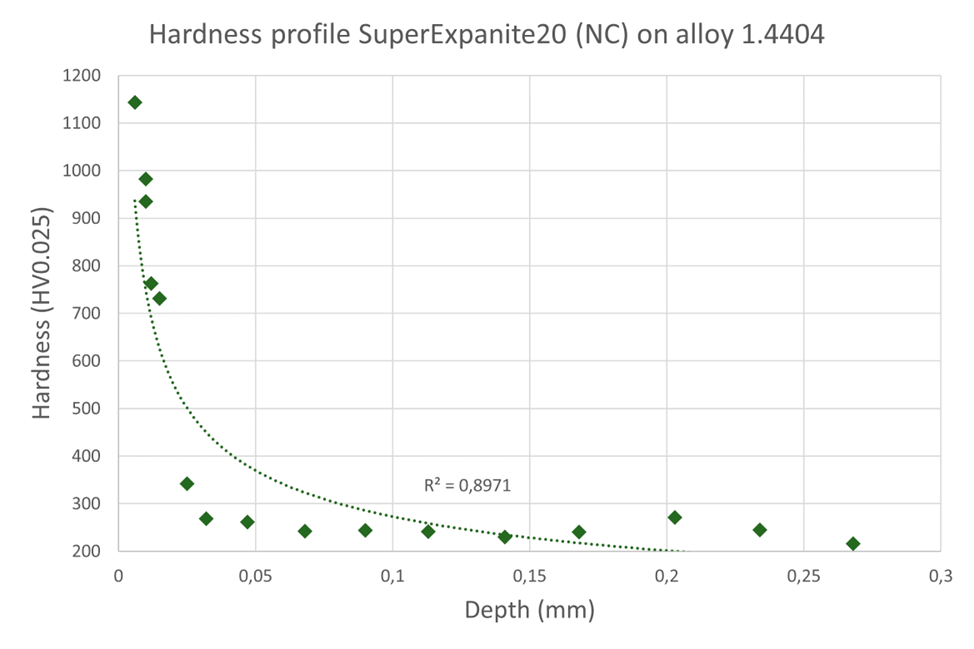
Fig. 2: Micrograph of expanded austenite layer created with ExpaniteLow-T process (as a part of SuperExpanite product) on AISI 316L alloy.
Fig. 3: Hardness profile of AISI 316L. Below the extremely wear-resistant surface layer (produced in the ExpaniteLow-T process, approx. 1.200 HV) lies a medium-hard transition layer (250-300 HV), which is created in the ExpaniteHigh-T process. Power curve fitted for visual aid.
To test wear resistance, Expanite tested some 316L samples hardened using its SuperExpanite® process to ASTM standard G 133. In this procedure (see Fig. 4), the SuperExpanite® treated test specimen is subjected to the reciprocating motion of 100Cr6 counterpart, under a contact pressure of 25N. The wear volume is determined after a sliding distance of 100 meters. The results are shown in Fig.: 2. The 316L sample with SuperExpanite® is 125 times more abrasion-resistant than the untreated sample.
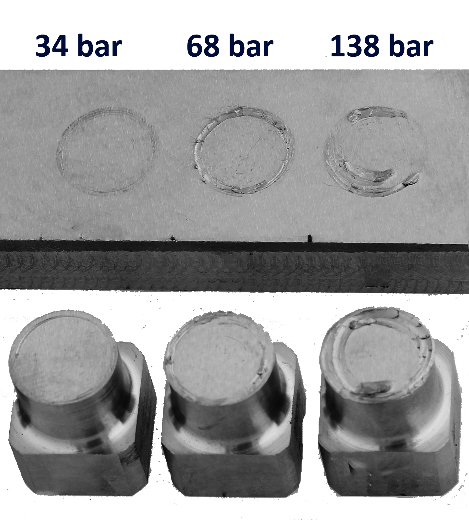
Fig. 4: Wear measurement according to ASTM G133
Following the ASTM G133, an ASTM G98 galling test (cold wear) was carried out with test specimens made of AISI 316L, the results of which are shown in Figures 5 and 6. In comparison to the unhardened test specimens, which already exhibit galling at a contact pressure of 35 bar, the test specimens hardened with SuperExpanite® do not show any galling even at a contact pressure of 2758 bar.  Even though the first plastic deformations occur at this pressure due to the yield strength being exceeded. The risk of galling is therefore eliminated in the case of both friction partners being hardened.
Fig. 5: Untreated AISI 316L test specimens after ASTM G98
Fig. 6: SuperExpanite treated AISI 316L test specimens after ASTM G98
Although the basic intention of conventional surface hardening processes is to produce harder surfaces, this is usually at the expense of corrosion resistance. This is where the Expanite process comes in. Tests have shown that 316L samples hardened with SuperExpanite® can spend up to 1,000 hours in a salt spray chamber without showing signs of corrosion (see figure 7).
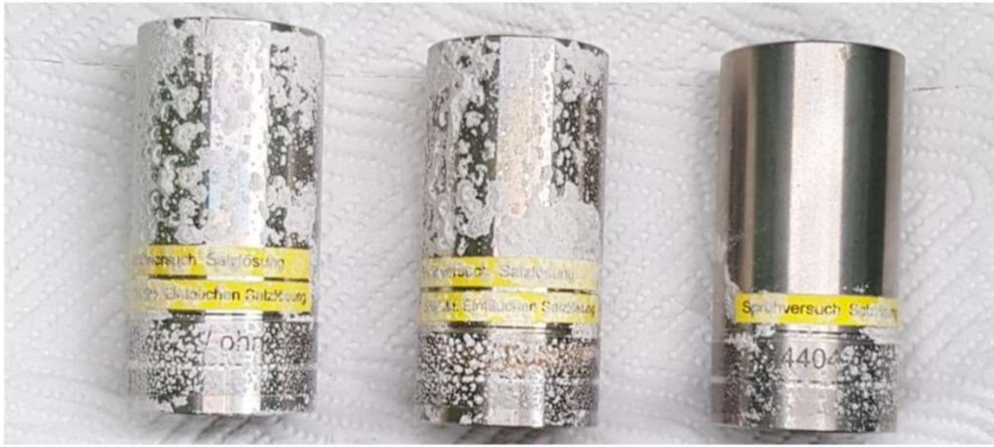
Fig. 7.: Results of the salt spray test on SuperExpanite hardened 316L alloy part (far right) as compared to competitors’ solutions
In some cases, the pitting corrosion resistance can even be significantly increased by the Expanite surface hardening process, even beyond the level of the unhardened base material. (Fig. 8). This effect is caused mainly by the large amount of nitrogen dissolved in the surface layer. A common formula for calculating the pitting resistance equivalent number (PREN) for alloys not containing tungsten, is given below (Eq. 1). It is easy to notice a relatively large 16x modifier in front of the nitrogen content expressed in weight percent (wt. %). This means that even small amounts of nitrogen have a significant positive influence on pitting resistance.

Eq. 1: PREN = %Cr + (3.3 x %Mo) + (16 x %N)

With the assumption of applicability of eq. 1 for large amounts of dissolved nitrogen [1], usually between 5 and 13 wt% [2], the PREN number can be calculated. For the AISI 316L alloy the calculated PREN numbers then range from around 100 even up to 230. A minimum of 4-fold increase over untreated material which has a PREN number of around 24. The underlying ExpaniteHigh-T zone can be characterized with PREN number of around 30, providing additional improvement even if the case hardening have been damaged or worn down. A potentiodynamic polarization curve for SuperExpanite treated and reference AISI 316 material is shown in Figure 8. This test is a common tool used to evaluate the pitting corrosion potential and characteristics of a metal. There are several highlights that can be derived from the graph, showing the undeniable positive influence of SuperExpanite treatment on the pitting corrosion resistance of austenitic alloys. Firstly, the open circuit potential of SuperExpanite treated sample is around 100mV higher than for the reference, suggesting better corrosion resistance in the absence of galvanic coupling. The polarization curve of the reference material also shows a much narrower passive region, that is characterized with many intermittent peaks (rugged line). Those lines indicate a sudden increase in current density (increased corrosion rate) and subsequent repassivation – initial pit formation. The plot obtained for SuperExpanite sample is free of those irregularities, and the material stays in the passive zone for potentials almost twice as large, with much more gradual decline towards the breakdown potential.
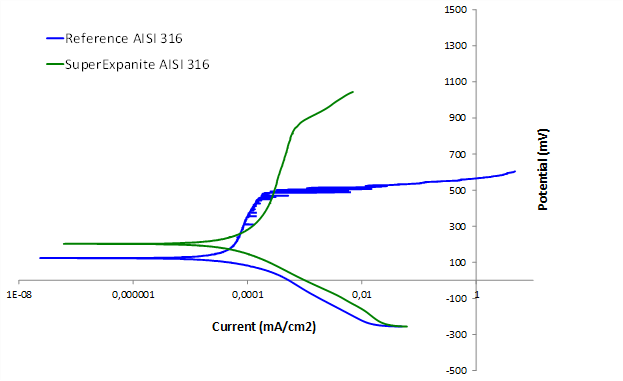
Fig. 8: Pitting resistance of AISI 1.4401 in seawater
Despite their widespread use, conventional surface layer hardening processes have various disadvantages. Harmful chemicals such as fluorides, chlorides, molten salts etc. are used. SuperExpanite®, on the other hand, which is produced using the two-stage process described above, is characterized by an environmentally conscious approach. Without the use of harmful chemicals, and no polluted wastewater Expanite represents an environmentally friendly and sustainable alternative. To summarize, the nitrocarburizing process specially developed by Expanite delivers excellent results in terms of both hardness and corrosion resistance for all stainless steel materials, not just limited to individual alloys. The process is therefore recommended for all types of stainless steel screws and fittings to extend the service life of the corresponding components and thus ensure increased product safety and interchangeability.  

Expanite interviene alla SchraubTec

Expanite invited to speak at Schraubtec Stuttgart February 19, 2025 The SchraubTec conference is all about screw connections in industry. In practical lectures and the exhibition, you will strengthen your specialist knowledge and skills on this important topic. Meet experts for screw connections, screw technology, screw tools as well as procurement, purchasing and management of C-parts. Get advice on current products and solutions for your screwing tasks.
Speaking at Schraubtec

Newsletter Q4/2023 (Disponibile in inglese)

Reflecting on 2023: continued expansion

We are proud to conclude that Expanite once again grew the business by a healthy two-digit figure – thanks to existing loyal customers and a solid portion of newcomers. We have expanded our presence in the market by attracting new colleagues, installing new equipment to increase capacity, and increase our product offering within more classic heat treatments. Throughout the year, we ran more than 20 webinars with an astonishing +500 participants and exhibited at 5 tradeshows in Asia, Europe, and North America – while doing what we enjoy the most; servicing existing and new customers.

Looking ahead: Exciting plans for 2024

One of the biggest events for Expanite in 2024 will be further expansion of our production capacity – within our chain of Expanite service centers. More details will follow during the first months of 2024. We are planning to launch new products – with focus on surface hardening of stainless steel and more classic heat treatment products – all to extend the range of solutions that we offer to our customers. Moreover, our work to document Expanite’s carbon and chemical footprint in accordance with international guidelines on sustainability is progressing, and we are planning to share our data during the first half of 2024. All with the purpose of staying transparent, and thereby build closer relationships and work together on today’s sustainability agenda.

Sostituzione del rivestimento in carburo di tungsteno sull’acciaio inox

“Recently, one of the world’s leading manufacturers of precision nozzles and nozzle systems has converted from tungsten carbide coatings to Expanite® surface hardening after experiencing quality issues with the coating cracking off. In cooperation with Expanite, the company found a hardening solution that made the surface of the nozzles resistant against chipping, cracking, delamination, etc. The specific customer performed field tests over a period of several months where the results from Expanite hardened nozzles showed significant increased lifetime without any premature failure. Based on the test results, the conversion to Expanite hardening was implemented. “It is far less expensive to apply Expanite hardening compared to many of the exotic coatings, hence the conversion resulted in better performance while reducing cost,” explained the customer. “By converting from a coating to a diffusion hardening process, issues with adhesion where eliminated, again whilst ensuring superior wear and corrosion resistance.”  

Newsletter Q3/2023 (Disponibile in inglese)

Discover Expanite’s Surface Hardening Revolutionizing Medical Device Materials

Revolutionizing Medical Device Materials
Expanite’s nitrocarburizing process enhances the hardness and corrosion resistance of stainless steel, extending the lifespan of medical applications while ensuring patient safety and cost-effectiveness. Stainless steel’s unique properties make it indispensable for devices exposed to liquids and tissues, but wear and corrosion have been persistent challenges. Expanite’s FDA-compliant process offers a breakthrough solution by deeply hardening both surface and underlying material, avoiding the pitfalls of traditional methods. Read the full article to learn how we’re enhancing stainless steel performance improving wear and corrosion resistence.

Eco Friendly Surface Hardening Replaces Hard Chrome Coatings

In general, coating methods that can prevent corrosion tend to add material and are often inconsistent in terms of the thickness of the applied layer. This can result in material accumulations on flat structures or material thinning at corners and edges where protection is reduced.  A solution to the above-mentioned problems involving stainless steels is surface hardening. This is not a coating process but a diffusion-based surface hardening process. Expanite’s patented technology not only harden the outermost layer, but also hardens in the underlying material to a greater depth. In many cases, this also results in improved corrosion resistance. 

Newsletter Q2/2023 (Disponibile in inglese)

Dear customers, partners, and friends of Expanite

Welcome to this summer edition of Expanite’s quarterly newsletter. With summer vacation closing in for many people – maybe it already started – it feels like a good time to recap on what has happened in the Expanite-sphere during the first six months of 2023. As announced in the beginning of the year, we strengthened our finances significantly towards the end of 2022. Part of the reason for doing this was to create the fundament for expanding our geographical market reach and product offerings. So, we added new team members within product development incl. heat treatment and within sales – the latest additions, are introduced below. The effects of these investments will be visible in the coming months. Another major initiative launched is relating to Expanite and sustainability. Since the foundation of our company, topics such removing aggressive chemicals in pre- and post-treatments, removing unnecessary transportation of parts, and offering clean & fast processing have been integrated parts of Expanite’s DNA. In the recent months we launched our new corporate identity and website, all to support these elements, and in the coming period we will intensify our communication and document how far Expanite is in supporting the global agenda of documenting and reducing our environmental impact. If you haven’t already visited our new website, please do so at www.expanite.com where one of featured stories is how Expanite supports our customer Raméns Valves in converting to more sustainable solutions by replacing hard-chrome plating. Download the case story here. Finally, just as a reminder – like previous years – Expanite is not closing treatment centers during the summer vacation period, so don’t hesitate to contact our customer service or sales staff in the coming weeks and months!

Newsletter Q1/2023 (Disponibile in inglese)

Check out our new website

We’re live! Check out our new website

After months of hard work, we are excited to share with you that Expanite’s new website has been launched in English and German – check out www.expanite.com. We have redesigned the site to make it even easier for you to learn more about Expanite’s offerings within surface hardening and heat treatment of nickel-based alloys, stainless steel and titanium. The aim has been to create a clean, modern design, making it easier for readers to navigate and find exactly what they are looking for – and thereby better present what Expanite stands for. We invite you to visit the new site and explore all of its features and keep an eye out for more  languages and improvements in the coming months. We would love to hear your feedback and suggestions, so please feel free to reach out to us with any comments or questions.  

Newsletter Q4/2022 (Disponibile in inglese)

Dear customers, partners, and friends of Expanite

Year 2022 is coming to an end, yet another year where reality was beating fiction. Where 2021 was affected by the pandemic and its consequences, 2022 will without doubt for many of us be the year where two uninvited/unwanted guests returned: war on European soil and global inflation. Albeit, for Expanite, 2022 was also the year where we and our partners installed new furnaces and thereby increased capacity in Germany, China, and the US. Expanite exhibited at more trade shows that ever before with CFIA in France, Anuga, Drinktec and Valve World in Germany, and Pack-Expo in the US – and thereby meeting many existing and new customers. Our organization grew with new highly skilled colleagues in Denmark, Sweden, Germany, and the US, and finally our popular webinars attracted more than 410 participants! 

Benvenuto a Thorsten Schild come Business Development Manager

Thorsten Schild
(Articolo in inglese) “Expanite, the Danish specialist in heat treatment and surface hardening of stainless steel and titanium, is thrilled to announce the addition of Thorsten Schild as Business Development Manager. With 25 + years expertise within the field, the appointment of Thorsten Schild will further strengthen Expanite’s commercial and technical service, and thereby support the companies ambitious growth strategy. Prior to joining Expanite, Thorsten Schild worked for Bodycote’s S3P division as group sales director, and he was one of co-founders of BorTec-SMT. All-in-all, Thorsten Schild can in many ways be regarded as one the most experienced people within sales and marketing of stainless steel surface hardening. Over more than 25 years, he has assisted countless customers across many industries globally on finding solutions for wear and galling on stainless steel. About Expanite: Expanite is a Danish company specializing in heat treatment and surface hardening of stainless steel and titanium. Expanite has established itself as a pioneer and trusted partner in the industry. The sustainable and patented surface hardening processes improves galling, wear and corrosion resistance on stainless steel and titanium parts in a wide range of applications and industries. The company has its head office in Hillerød near Copenhagen and service centers and licensees in the USA, Germany, Korea, and China.